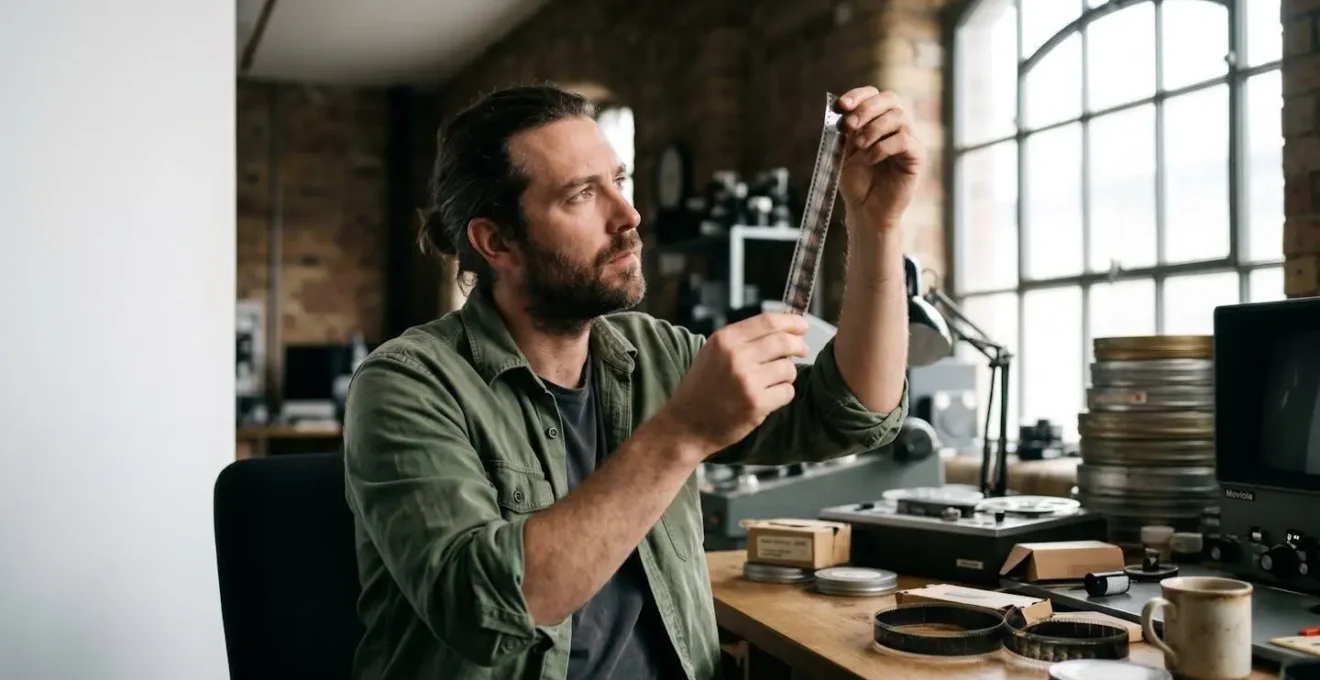
Stop searching for ‘cheap’ archive footage; the real savings for UK filmmakers lie in strategically exploiting legal frameworks and creative alternatives to commercial archives.
- Leverage the UK’s ‘fair dealing’ doctrine to legally use clips for criticism, review, or reporting current events.
- For monetised projects, only CC-BY and CC-BY-SA licenses safely permit use on platforms like YouTube and VOD.
- Commissioning ‘limited style’ animation can be up to 50% cheaper than licensing equivalent historical footage.
Recommendation: Before licensing any clip, conduct a multi-layered rights audit (footage, music, talent) to avoid catastrophic budget overruns.
For any UK documentary maker, the scenario is painfully familiar. You find the perfect ten-second clip to bring a historical sequence to life, only to be quoted a fee of £5,000 by a major commercial archive. This single cost can derail an entire independent production budget, forcing filmmakers to compromise their vision. The standard advice often circles around sourcing « public domain » material or browsing huge commercial libraries, which is the very source of the problem.
This approach is fundamentally flawed for UK creators. It overlooks the crucial legal and strategic nuances that can unlock vast amounts of material for a fraction of the cost. The solution isn’t about finding a mythical, cheap-for-all archive. Instead, it’s a three-pronged strategy: mastering UK-specific legal frameworks like ‘fair dealing’, becoming surgically precise in navigating Creative Commons licenses for commercial use, and embracing creative substitutes like animation not as a second-best option, but as a savvy financial choice.
This guide moves beyond the generic and provides a budget-conscious, strategic roadmap. We will deconstruct the real costs, reveal the licensing traps, and equip you with the practical knowledge to tell powerful historical stories without being priced out of the market. It’s time to shift from being a passive footage buyer to an active rights strategist.
Summary: UK Filmmaker’s Guide to Affordable Archive Footage
- Why Do Most Filmmakers Ignore Free Archive Sources Covering Pre-1928 Material?
- How to Reduce BBC Archive Fees by 60% for Educational Documentary Use?
- CC-BY or CC-BY-NC: Which Licence Allows Your Monetised Documentary?
- The 1960s Clip That Cost £12K in Unexpected Licensing After Publication
- How to Tell 1940s Stories When Archive Clips Cost More Than Your Entire Budget?
- Exclusive Licence or Exclusive Production: What Does « Only on » Really Mean?
- Should You Sell Hand-Drawn as « Artisanal Craft » or « Classic Nostalgia »?
- How Can UK Animators Use Hand-Drawn Methods Without Being Priced Out?
Why Do Most Filmmakers Ignore Free Archive Sources Covering Pre-1928 Material?
The promise of a vast, free library of pre-1928 footage is a tempting one for budget-conscious filmmakers. Yet, many experienced UK producers treat this trove with extreme caution, and for good reason. The primary issue is not a lack of material—indeed, major archives like British Pathé hold over 85,000 film items—but a dangerous oversimplification of copyright law, often imported from US-centric advice.
In the United States, a fixed date (currently 1928) is often used as a clear cutoff for work entering the public domain. However, this does not apply in the United Kingdom. UK copyright law generally operates on a basis of ‘life of the author plus 70 years’. This means a film made in 1925 by a director who died in 1980 will remain in copyright in the UK until 2050. Assuming a pre-1928 clip is automatically ‘free’ is a significant legal risk.
This confusion is compounded by online archives that may misclassify footage. A platform might label a clip as ‘Public Domain’ based on its US status, inadvertently creating a legal trap for a UK filmmaker whose final work will be distributed and scrutinised under UK law. The perceived ‘free’ asset suddenly becomes a potential liability, requiring expensive legal clearance or removal post-publication. Therefore, producers ignore it not from ignorance of its existence, but from a savvy understanding that navigating its true legal status is a complex, time-consuming task that often outweighs the benefit of it being ‘free’.
How to Reduce BBC Archive Fees by 60% for Educational Documentary Use?
The BBC archive is a treasure trove for documentary filmmakers, but its standard licensing fees can be prohibitive. With rates historically in the realm of £450 per minute for certain rights packages, a few clips can quickly consume an independent budget. However, for projects that fit specific criteria, the UK’s powerful ‘fair dealing’ doctrine offers a legitimate path to using this material at a significantly reduced, or even zero, cost.
Fair dealing is a legal framework, not an informal agreement. Specifically, Section 30 of the Copyright, Designs and Patents Act 1988 allows for the use of copyrighted material for the purposes of criticism, review, or reporting current events. For a documentary filmmaker, this means you can incorporate a BBC clip not just for illustration, but to actively analyse, critique, or place it in a new journalistic context. The use must be ‘fair’, a judgment based on the purpose, the amount used, and the impact on the original copyright holder’s market. Simply using a clip because it looks good will not qualify; your narration and edit must be demonstrably engaging with the clip’s content.
To successfully leverage fair dealing and protect your production, meticulous documentation is key. You must provide sufficient acknowledgement of the BBC as the source and maintain a written justification of why your use qualifies. For commercial projects, this justification forms the basis of a legal opinion letter, which is essential for securing Errors & Omissions (E&O) insurance. By structuring your sequences with fair dealing in mind from the outset, you are not ‘getting away with it’; you are strategically employing a legal right available to UK creators.
CC-BY or CC-BY-NC: Which Licence Allows Your Monetised Documentary?
Creative Commons (CC) licenses appear to be a fantastic solution for filmmakers on a budget, offering a wealth of material for free. However, the dream of a free-for-all archive quickly turns into a licensing nightmare if you don’t understand one critical distinction: the difference between commercial and non-commercial use. For any filmmaker who intends to earn money from their documentary—be it through YouTube ad revenue, VOD platform sales, or even Patreon support—this is the most important detail.
The key is the « NC » (Non-Commercial) clause. Any license including « NC, » such as CC BY-NC or CC BY-NC-ND, explicitly prohibits you from using the material in a project intended for commercial advantage or monetary compensation. While film festival submissions are often considered acceptable, monetising your film on YouTube or selling it on Vimeo On Demand would constitute a breach of the license. The « gray area » around crowdfunding platforms like Patreon often leads creators to avoid NC material altogether to be safe.
Therefore, for a monetised documentary, you must filter your search exclusively for licenses without the « NC » tag. The CC BY and CC BY-SA (ShareAlike) licenses are generally your safest bets. Both permit commercial use, provided you give appropriate attribution. The ‘SA’ clause adds a condition: if you use a CC BY-SA clip, your entire film must be released under the same license. This can create conflicts with distributors who demand exclusive rights, making the simple CC BY license the most flexible and commercially friendly option for independent filmmakers.
The following table, based on guidance from Creative Commons, breaks down how different licenses impact common monetisation streams for a UK filmmaker.
| License Type | YouTube Ad Revenue | Film Festival Prizes | Patreon Support | VOD Platform Sales | Attribution Required |
|---|---|---|---|---|---|
| CC BY | ✓ Permitted | ✓ Permitted | ✓ Permitted | ✓ Permitted | Yes |
| CC BY-NC | ✗ Prohibited | ✓ Permitted | ✗ Gray Area | ✗ Prohibited | Yes |
| CC BY-SA | ✓ Permitted | ✓ Permitted | ✓ Permitted | ✓ Permitted* | Yes + ShareAlike |
| CC BY-NC-ND | ✗ Prohibited | ✓ Permitted | ✗ Gray Area | ✗ Prohibited | Yes |
| *CC BY-SA requires your entire documentary to be released under the same ShareAlike license, which may conflict with distribution agreements | |||||
The 1960s Clip That Cost £12K in Unexpected Licensing After Publication
A cautionary tale often shared between documentary producers involves the director who licensed a seemingly simple 1960s street scene for a modest fee. After the film’s release, a barrage of legal letters arrived. The background music playing from a shop radio required a separate music synchronisation fee. A recognisable actor walking past in the crowd demanded a talent re-use fee. A prominent brand logo on a van in the shot triggered a trademark clearance issue. The initial £1,000 clip spiralled into over £12,000 in unexpected costs and legal headaches.
This scenario illustrates the critical concept of ‘stacked rights’. When you license a piece of archive footage, you are often only licensing the visual material itself. You are not automatically cleared for any other copyrighted or protected elements contained within that footage. This is the single biggest financial trap for unwary filmmakers. Every single clip must be audited not just for its content, but for its layers of intellectual property.
These layers can include:
- Footage Rights: The base license from the archive holder (e.g., British Pathé, Getty).
- Music Rights: Both the ‘sync’ right to pair the music with visuals and the ‘master’ right for the specific recording.
- Talent/Personality Rights: Fees for recognisable actors, presenters, or even members of the public in some contexts.
- Trademark/Artwork Rights: Clearance for visible logos, copyrighted paintings on a wall, or even distinctive product designs.
- Territorial Rights: A UK-only license is cheaper but will land you in trouble if your film gets picked up for worldwide distribution.
To avoid this kind of budget catastrophe, a rigorous pre-production clearance process is not optional; it’s a fundamental part of a producer’s job. Proactively identifying and clearing these stacked rights before the edit is locked is the only way to ensure your budget remains intact.
Action Plan: The Pre-Clearance Audit
- Points of contact: Identify and list all potential rights holders within the clip—footage owner, music publisher, on-screen talent, and owners of any visible brands or artwork.
- Collect: Inventory every single third-party element that is visible or audible, no matter how brief its appearance.
- Coherence: Cross-reference the license terms for each element (e.g., territory, duration, media) against your intended distribution plan to flag conflicts.
- Fairness Assessment: If relying on fair dealing, document precisely why the use is transformative or critical, not merely illustrative, to strengthen your legal position.
- Integration Plan: Secure a legal opinion letter supporting your clearance decisions and ensure your Errors & Omissions (E&O) insurance policy covers these claims before any public exhibition.
How to Tell 1940s Stories When Archive Clips Cost More Than Your Entire Budget?
Telling stories from the 1940s presents a unique challenge. The most evocative footage is often held by major archives with high licensing fees, whilst « free » material is scarce and legally complex under UK law. When the cost of a few key clips exceeds the entire production budget, filmmakers must pivot to more creative and strategic sourcing methods. The solution is to think beyond traditional video archives and embrace alternative storytelling assets.
One powerful but underused strategy is to lean into audio archives and still photography. A compelling eyewitness account from a sound archive, paired with high-resolution scans of period photographs, letters, and documents, can create a more intimate and emotionally resonant sequence than a silent, grainy video clip. This approach allows for greater narrative control and can be achieved for a fraction of the cost, as licensing for audio and stills is often cheaper and simpler.
Furthermore, UK filmmakers should actively explore educational access programmes. Initiatives like the Archives for Education project, which partners with the BFI National Archive and BBC Archive, provide pathways for emerging filmmakers and educational institutions to access high-quality films for creative reuse under specific licensing terms. These programmes are designed to foster talent and offer a legitimate low-cost alternative to purely commercial routes. Approaching regional film archives and university special collections can also unearth incredible, locally-relevant material that national archives may have overlooked, often with more flexible and affordable licensing for independent projects.
Exclusive Licence or Exclusive Production: What Does « Only on » Really Mean?
Securing a distribution deal with a major platform like Netflix or Channel 4 is a dream for many documentary makers. However, this dream can become a contractual nightmare if your archive licensing isn’t meticulously managed. The conflict arises when a distributor demands an « exclusive » license to your film, granting them sole rights to exhibit it. The problem is that you, the filmmaker, likely do not hold exclusive, perpetual, worldwide rights to all the third-party archive material within your film.
You may have licensed a clip for UK-only use for a term of 5 years. Or perhaps you used a clip under ‘fair dealing’, which is a right you hold but cannot transfer or sub-license to the distributor. When you sign a standard distribution agreement that grants the platform « all rights in and to the film », you are potentially promising rights you don’t actually own. If the archive holder of that UK-only clip sees your film on the distributor’s global platform, they can pursue legal action—and the distributor will hold you liable for the breach.
To prevent this, you must become an expert negotiator, not of money, but of contractual language. Your goal is to insert specific ‘carve-out’ clauses into your distribution agreement. These clauses act as a shield, making it clear that the distributor’s exclusivity is subject to the pre-existing limitations of your third-party archive licenses. This protects you from being in breach of your agreement when a distributor’s use exceeds the scope of your original license.
- Clause for Pre-existing Limits: State that the grant of exclusivity does not override or expand the rights obtained for third-party material.
- Specify Non-transferable Rights: Explicitly note that footage used under fair dealing or educational licenses cannot be re-licensed or sub-licensed by the distributor.
- Match Territorial Scope: Negotiate territorial carve-outs that prevent the distributor from showing the film in territories for which you have not cleared the archive rights.
- Acknowledge Time Limits: Require the distributor to acknowledge the expiration dates of time-limited archive licenses within the agreement.
Should You Sell Hand-Drawn as « Artisanal Craft » or « Classic Nostalgia »?
When a key historical event is undocumented on film or the existing footage is prohibitively expensive, many filmmakers hit a wall. This is where commissioning hand-drawn animation ceases to be a purely stylistic choice and becomes a powerful strategic tool. The question isn’t just whether to use animation, but how to frame its value. The answer, from a budget strategist’s perspective, is to sell it as a cost-effective and creatively superior solution to an archival black hole.
Consider the raw numbers. Licensing a 30-second historical sequence with all rights for theatrical distribution can easily cost between £1,600 and £3,500. As a recent cost-benefit analysis shows, commissioning a simple, ‘limited animation’ style sequence from a graduate animator to depict the same event could cost between £1,200 and £2,000. That represents a direct saving of 25-43%. Even more critically, the animation rights are typically granted in perpetuity with unlimited distribution, unlike the time-limited and geographically restricted licenses of archive footage.
This financial argument gives you a powerful position. You can present animation to funders and commissioners not as a whimsical « artisanal craft, » but as a pragmatic solution that offers greater creative control and long-term value. Whether you frame it as « classic nostalgia » to match a period aesthetic or as a stark, modern interpretation, the underlying benefit is the same: you are creating a unique visual asset that you own outright, for less than the cost of renting a piece of history.
The table below provides a clear cost-benefit analysis for an independent UK production, demonstrating the financial advantage of animation over licensed footage in common scenarios.
| Scenario | Licensed Archive Footage | Commissioned Hand-Drawn Animation | Cost Difference |
|---|---|---|---|
| 10-second 1950s street scene | £800-£1,200 (per-second rates) | £400-£800 (student/graduate animator) | Save 33-50% |
| 30-second historical sequence | £1,600-£3,500 (all rights theatrical) | £1,200-£2,000 (limited animation style) | Save 25-43% |
| Rights package | Time-limited + territorial restrictions | Perpetual ownership + unlimited distribution | Greater long-term value |
| Stylistic control | Limited to available footage | Complete creative control matching doc aesthetic | Unique visual identity |
| Based on UK market rates for independent documentary production 2024-2026 | |||
Key takeaways
- ‘Fair dealing’ is a powerful UK-specific tool for using copyrighted clips, provided the use is ‘fair’ and properly acknowledged.
- For monetised projects, avoid all Creative Commons ‘Non-Commercial’ (NC) licenses, as they prohibit use on ad-supported or VOD platforms.
- Always budget for ‘stacked rights’—a single clip may require separate fees for footage, music, talent, and trademarks.
How Can UK Animators Use Hand-Drawn Methods Without Being Priced Out?
Once a filmmaker is convinced that animation is a viable alternative to expensive archive footage, the next question is: how can I afford it? The key is to look beyond established animation studios, whose overheads lead to higher day rates, and tap into the UK’s rich ecosystem of emerging talent. By being strategic about sourcing and commissioning, producers can get high-quality animation that fits an independent documentary budget.
The most effective strategy is to connect with animators at the beginning of their professional careers, when they are eager to build their portfolios and showreels. Contacting prestigious UK animation schools like the Royal College of Art or the National Film and Television School (NFTS) around their graduate showcases can lead to collaborations with the next generation of talent at competitive rates. Specialized UK creative platforms like The Dots are also excellent for finding recent graduates whose day rates (£150-£300) are a fraction of the £500+ charged by established freelancers or studios.
Furthermore, producers can significantly reduce costs by being smart about the type of animation they commission. Requesting ‘limited animation’ techniques—which involve using fewer frames per second, holding on static backgrounds, or simplifying character movement—can reduce the total labour hours by as much as 40-60% without compromising the storytelling impact. Offering flexible payment structures, such as a smaller upfront fee plus a percentage of any distribution revenue, can also make a project more attractive to an emerging animator. It’s a win-win: the animator gets a credited role in a professional film and a stake in its success, and the producer gets a unique animated sequence for a manageable cost.
- Contact UK animation schools (e.g., RCA, NFTS) during graduate showcases.
- Use UK creative platforms like The Dots to find recent graduates with competitive rates.
- Explore student placement programmes with university animation departments.
- Commission ‘limited animation’ styles to reduce labour hours significantly.
- Offer deferred payment structures with a share of future revenue.
- Provide prominent screen credits to incentivize animators building their showreels.
Ultimately, navigating the world of archive footage as a UK filmmaker is an act of strategic creativity. It requires moving beyond the role of a mere consumer of images and becoming a savvy architect of rights, a legal pragmatist, and an innovative storyteller. By mastering fair dealing, decoding licenses, and embracing alternatives like animation, you are not cutting corners; you are taking control. Start building your next historical documentary not with a search for footage, but with a strategic rights and alternatives plan.