Equipment & Home Theater
Creating a home theater transforms how you experience movies, sports, and television. What once required a trip to the cinema can now unfold in your living room or dedicated media space, with picture quality and sound that rival commercial theaters. But achieving this immersive experience requires understanding the equipment ecosystem and how different components work together.
The world of home theater equipment encompasses far more than simply buying a large television. It involves display technology, audio systems, streaming devices, calibration tools, and the physical setup of your space. Each element plays a crucial role in the final experience, and making informed choices means understanding what each component contributes and how your specific needs shape those decisions.
Whether you’re setting up your first system or upgrading existing equipment, this comprehensive resource will guide you through the essential knowledge needed to build a home theater that delivers exceptional performance within your budget and space constraints.
Understanding Home Theater Equipment Essentials
Think of a home theater system as an orchestra where every instrument must be in harmony. Your display provides the visual performance, your audio system creates the sonic landscape, and your source devices deliver the content. When these elements work together seamlessly, they create something greater than the sum of their parts.
Core Components That Matter
Every home theater system requires three fundamental categories of equipment. The display system (television or projector with screen) forms your visual foundation, determining picture size, resolution, and image quality. Your audio system ranges from streamlined soundbars to elaborate surround sound configurations with multiple speakers and subwoofers. Finally, source devices like streaming boxes, Blu-ray players, and game consoles provide the content you’ll actually watch.
Beyond these essentials, many systems benefit from supplementary equipment. AV receivers act as central hubs, managing connections and processing audio formats. Media servers store your personal content library. Calibration tools help optimize both picture and sound for your specific environment.
The Integration Factor
Modern home theater equipment emphasizes connectivity and ecosystem compatibility. Devices communicate through standards like HDMI, which carries both video and audio signals. Features such as HDMI-ARC (Audio Return Channel) and eARC simplify connections by reducing cable runs. Wireless technologies like Bluetooth and Wi-Fi enable streaming from mobile devices and eliminate some cable clutter, though wired connections typically offer superior reliability for primary components.
Understanding how components connect and communicate helps you avoid compatibility issues and future-proofs your investment as new technologies emerge.
Display Technology: From Screens to Projectors
Your display choice fundamentally shapes your viewing experience, influencing everything from room layout to ambient light considerations. The decision between television and projection systems depends on your space, budget, and viewing preferences.
Television Technologies Explained
Modern televisions employ several distinct panel technologies, each with characteristic strengths. OLED displays produce perfect blacks by turning off individual pixels, creating exceptional contrast and vibrant colors ideal for darkened viewing environments. QLED and LED-LCD panels use backlighting systems and achieve higher brightness levels, performing better in rooms with ambient light while offering excellent value across various price points.
Screen size selection follows a simple principle: larger displays create more immersive experiences, but your viewing distance determines the optimal size. A helpful guideline suggests sitting at a distance roughly 1.5 to 2.5 times the screen diagonal for 4K content. A 65-inch display works well for seating positioned 8 to 11 feet away, while dedicated theater rooms might accommodate 75-inch or larger screens.
Resolution matters significantly for larger screens and closer viewing distances. While 4K (Ultra HD) has become the standard, offering four times the pixels of 1080p, emerging 8K displays provide even greater detail for very large screens, though native 8K content remains limited.
Projection Systems for Dedicated Rooms
Projectors excel in dedicated home theater environments where you control lighting conditions. They deliver screen sizes exceeding 100 inches at price points often lower than comparably sized televisions. Modern projectors divide into lamp-based, LED, and laser models, each offering different brightness levels, lifespan expectations, and maintenance requirements.
Screen selection proves equally important as the projector itself. Fixed-frame screens provide the flattest surface and best image quality, while retractable models offer flexibility in multi-purpose rooms. Screen materials affect brightness, contrast, and viewing angles—some reject ambient light while others optimize for complete darkness.
Audio Systems That Transform Your Experience
Sound quality profoundly impacts immersion, often more than viewers initially realize. Dialogue clarity, directional effects, and deep bass response work together to create the sonic dimension that makes content feel alive and engaging.
Soundbar vs. Component Systems
Soundbars offer simplified installation and significant audio improvement over television speakers in a single cabinet. Premium models incorporate multiple drivers, dedicated center channels for dialogue, and wireless subwoofers for bass. Some create virtual surround sound through psychoacoustic processing, simulating multi-speaker setups without physical rear speakers.
Component systems with separate speakers provide authentic surround sound by physically placing drivers around your viewing position. This approach delivers superior directional accuracy and dynamic range but requires more space, additional wiring, and careful speaker placement.
Surround Sound Configurations
Speaker configurations use numerical notation describing channel counts. A 5.1 system includes five speakers (front left, center, front right, rear left, rear right) plus one subwoofer. Expanding to 7.1 configurations adds side surround speakers for improved sound field continuity. Modern object-based audio formats like Dolby Atmos introduce height channels, creating three-dimensional soundscapes described as 5.1.2 (two height speakers) or more elaborate configurations.
The AV receiver forms the system’s brain, decoding audio formats, powering speakers, and managing sources. Receiver selection should account for your speaker configuration, desired audio formats, connection requirements, and room size. Power ratings measured in watts per channel indicate the receiver’s ability to drive your specific speakers to adequate volume levels.
Setting Up Your Home Theater Space
Equipment quality matters tremendously, but room characteristics and component placement significantly influence the final experience. Even modest equipment properly configured often outperforms premium gear carelessly installed.
Room Acoustics and Placement
Sound behaves differently in various spaces based on room dimensions, surface materials, and furnishings. Hard surfaces like bare walls and floors reflect sound, creating echoes and muddying clarity. Soft materials—carpeting, curtains, upholstered furniture—absorb sound, reducing reflections and tightening bass response.
Speaker placement follows established guidelines for optimal performance. Front speakers should form an arc around the primary seating position, with the center channel at screen height for dialogue anchoring. Subwoofers prove less directional, but corner placement typically amplifies bass output while midwall positions often provide smoother response. Surround speakers work best slightly above ear level, creating an enveloping sound field without drawing attention to their specific locations.
Seating and Viewing Distance
Seating position dramatically affects both audio and video quality. The primary viewing location should align with the display’s center at a slight downward viewing angle, reducing neck strain during extended viewing. Multiple seating rows require careful consideration of sight lines—elevated rear seating ensures unobstructed views.
Audio sweet spots exist where all speakers reach the listener simultaneously, creating cohesive soundstages. While only one position achieves theoretical perfection, proper speaker placement and receiver calibration can expand this zone to accommodate multiple viewers comfortably.
Smart Features and Connectivity Options
Contemporary home theater equipment emphasizes network connectivity and smart features that simplify operation and expand capabilities. Streaming integration has become standard, with most displays and many receivers including built-in apps for popular services.
Dedicated streaming devices offer advantages over built-in television apps, including faster processors, more regular software updates, and broader codec support. They connect via HDMI and many support advanced features like Dolby Vision HDR and high-bitrate audio formats that maximize your equipment’s capabilities.
Control systems range from traditional remotes to smartphone apps and voice assistants. Universal remotes consolidate multiple device controls into single units, while automation platforms enable sophisticated scenes that adjust lighting, lower screens, and power on components with single commands.
Network connectivity enables firmware updates that improve performance and add features over time. Wired Ethernet connections provide the most reliable streaming experience for bandwidth-intensive 4K content, though modern Wi-Fi standards work well for most applications when router placement and signal strength prove adequate.
Choosing Equipment Within Your Budget
Building a home theater requires balancing aspirations against financial realities. The good news: compelling experiences are achievable across various budget levels through strategic prioritization and smart compromises.
Start by identifying your primary use cases and space constraints. Sports enthusiasts might prioritize screen size and brightness for daytime viewing, while film lovers in controlled environments might emphasize contrast and audio quality. These priorities guide where to invest and where to economize.
Consider a phased approach that begins with core components and expands over time. An initial investment might include a quality display and competent soundbar, with plans to add surround speakers, subwoofers, and upgraded sources as budget allows. This strategy delivers immediate improvement while establishing a foundation for future expansion.
Researching specifications helps distinguish meaningful differences from marketing hype. Focus on measurements that impact real-world performance—contrast ratios, color gamut coverage, frequency response—rather than proprietary feature names that may offer minimal practical benefit. Professional reviews and calibrated measurements provide objective data beyond manufacturer claims.
Understanding home theater equipment empowers you to create entertainment experiences tailored to your specific space, preferences, and budget. The technology continues evolving, but fundamental principles remain constant: quality sources displayed on capable screens with immersive audio create the magic that transforms ordinary viewing into extraordinary experiences. By grasping how components interact and prioritizing what matters most for your situation, you’ll build a system that delivers satisfaction for years to come.

Why Does Your 4K TV Look Muddy? Solving the 1080p Downgrade on 4K Sources
The frustratingly muddy image on your 4K screen isn’t a random glitch; it’s a deliberate, protective downgrade forced by a communication breakdown somewhere in your home theatre setup. Your devices perform a « digital handshake » to verify rights (HDCP) and capabilities…
Lire la suite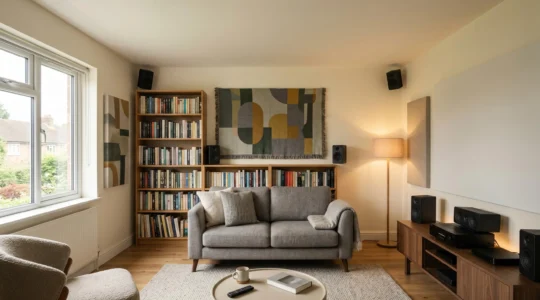
How Can Small UK Living Rooms Deliver Cinema-Level Immersion on 4m Walls?
Achieving immersive sound in a typical UK living room has less to do with the price of your speakers and more to do with controlling your room’s acoustics. Proper speaker placement and basic acoustic treatment consistently outperform more expensive equipment…
Lire la suite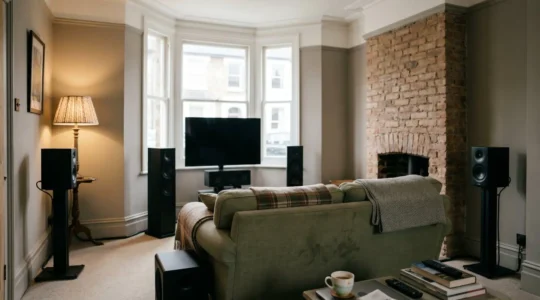
How Can UK Beginners Set Up 7.1 Surround Without £800 Installation Fees?
The thought of configuring a 7.1 surround sound system, with its complex AV receiver and tangle of wires, is enough to make many UK home cinema enthusiasts consider paying steep professional installation fees. However, achieving immersive, cinema-quality audio is less…
Lire la suite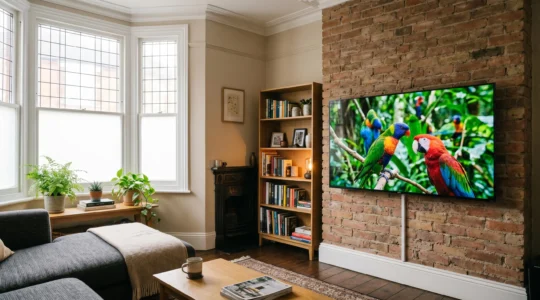
Cinema-Accurate Colour on Your UK TV: A Guide to Calibration Without £500 Tools
Achieving true-to-life colour on your TV is not about buying expensive equipment, but about systematically reversing the « showroom » settings designed to grab attention in a store. Out-of-the-box settings like ‘Vivid’ or ‘Dynamic’ are intentionally oversaturated to compete under harsh retail…
Lire la suite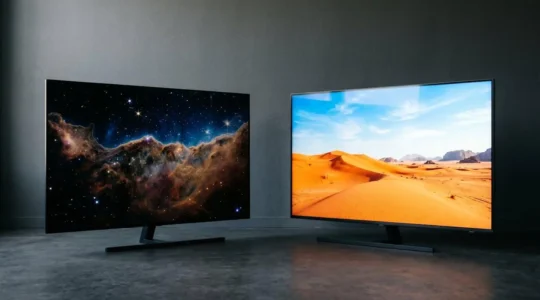
OLED Perfect Blacks or QLED Brightness: Which Technology for Your Viewing Room?
The best TV technology isn’t OLED or QLED; it’s the one that perfectly matches your room’s lighting and your personal viewing habits. Your room’s brightness is the deciding factor. A simple smartphone app can tell you if your room needs…
Lire la suite