In summary:
- Subject authenticity is not achieved by waiting, but by actively managing psychological and environmental factors.
- The « 48-hour rule » is based on the Hawthorne effect and cognitive fatigue, where the brain stops registering the camera as a novelty.
- Minimising your crew and equipment « footprint » is the most effective technical strategy for reducing subject self-consciousness.
- Ethical crises require a framework of stewardship, balancing the roles of observer and human.
- Even large crews can achieve efficiency through rigorous pre-shoot coordination and clear communication protocols.
You’ve been there. The scene is perfect. The emotion is raw, the dialogue is genuine, and for a moment, you’ve captured lightning in a bottle. Then it happens: a fleeting glance into the lens, a subtle shift in posture. The spell is broken. The authenticity you’ve worked so hard to foster evaporates, and your subject is once again « acting » for the camera. This is the central frustration for any observational filmmaker. The conventional wisdom is to « build rapport » or « use a small camera, » but these are just fragments of a much larger, more strategic picture.
The truth is that achieving invisibility is not a passive waiting game. It’s an active craft, a deliberate methodology that combines psychological understanding with disciplined technical execution. The key isn’t simply to be liked by your subjects; it’s to make your presence so constant and non-interactive that their brains literally stop processing you as an anomaly. It’s about engineering a state of « environmental normalization » where the camera and crew become as unremarkable as the furniture in the room.
This guide moves beyond the platitudes to provide a strategic framework for achieving that invisibility. We will dissect the psychological mechanism behind the famed « 48-hour rule, » provide concrete techniques for filming in intimate settings, and navigate the complex ethical tightrope of observing a crisis. We’ll explore why a lean crew is often more effective and how even larger teams can improve their coordination to minimise their impact, ultimately allowing you to capture the unguarded truth that lies at the heart of your story.
This article delves into the practical strategies and psychological principles that enable documentary crews to capture truly authentic behaviour. Explore the sections below to master the craft of invisibility on set.
Contents: A Guide to Observational Invisibility
- Why Do Documentary Subjects Stop « Acting » After 2 Days of Constant Filming?
- How to Film Family Dinners Where Everyone Forgets You’re Recording?
- Should You Stop Filming to Intervene When Subjects Make Harmful Decisions?
- The 3-Camera Observational Setup That Made Subjects Camera-Conscious for Weeks
- How to Stay Observational When Your Subject Experiences a Crisis on Camera?
- How to Spot Series That Value Character Change Over Shocking Plot Turns?
- How to Stop Lighting and Camera Crew Disagreements Delaying Every Setup?
- How Can 6-Person Crews Finish Shoots 3 Hours Faster Through Better Coordination?
Why Do Documentary Subjects Stop « Acting » After 2 Days of Constant Filming?
The phenomenon of subjects gradually reverting to their natural behaviour after approximately 48 hours of filming is not anecdotal; it’s rooted in a well-documented psychological principle known as the Hawthorne effect. This effect describes the tendency for individuals to modify their behaviour simply because they are aware of being observed. Initially, this awareness triggers a performance—subjects become more guarded, polite, or try to present an idealised version of themselves. They are actively managing the impression they are making on the invisible audience behind the lens.
However, maintaining this performance is cognitively expensive. The human brain is not wired for sustained, conscious self-monitoring. After a day or two of constant exposure to the camera and crew, a crucial shift occurs: cognitive fatigue sets in. The novelty of being filmed wears off. The camera, which was once a primary focus of their attention, is downgraded to background noise. As leading researchers Fox, Brennan, and Chasen noted when defining the principle, the core of the issue is this awareness. As they put it in their study of the phenomenon:
The Hawthorne effect refers to a tendency in some individuals to alter their behavior in response to their awareness of being observed.
– Fox et al., Simply Psychology – Hawthorne Effect Study
This is the moment of breakthrough for the observational filmmaker. When the mental energy required to « act » outweighs the perceived importance of doing so, authenticity emerges. The subject’s brain, overwhelmed with the normal demands of life, can no longer afford to allocate resources to the camera. This is reinforced by historical research on the Hawthorne effect which demonstrates that changes in behaviour often cease when the observation period ends, proving the behaviour was a direct result of the observation itself.
Ultimately, the 48-hour rule is less about time and more about reaching a saturation point where the artifice of performance collapses under the weight of normal life, allowing the filmmaker to finally capture reality.
How to Film Family Dinners Where Everyone Forgets You’re Recording?
The family dinner is a crucible for the observational filmmaker. It’s a nexus of complex interpersonal dynamics, subtle emotional cues, and rapid-fire conversation—a goldmine of authenticity. Yet, it’s also a high-risk environment for creating camera-consciousness. The intimacy of the setting makes any intrusive equipment feel like a glaring spotlight. The key to success is not just being present, but achieving a state of environmental normalization, where your footprint is so minimal it becomes part of the room’s natural texture.
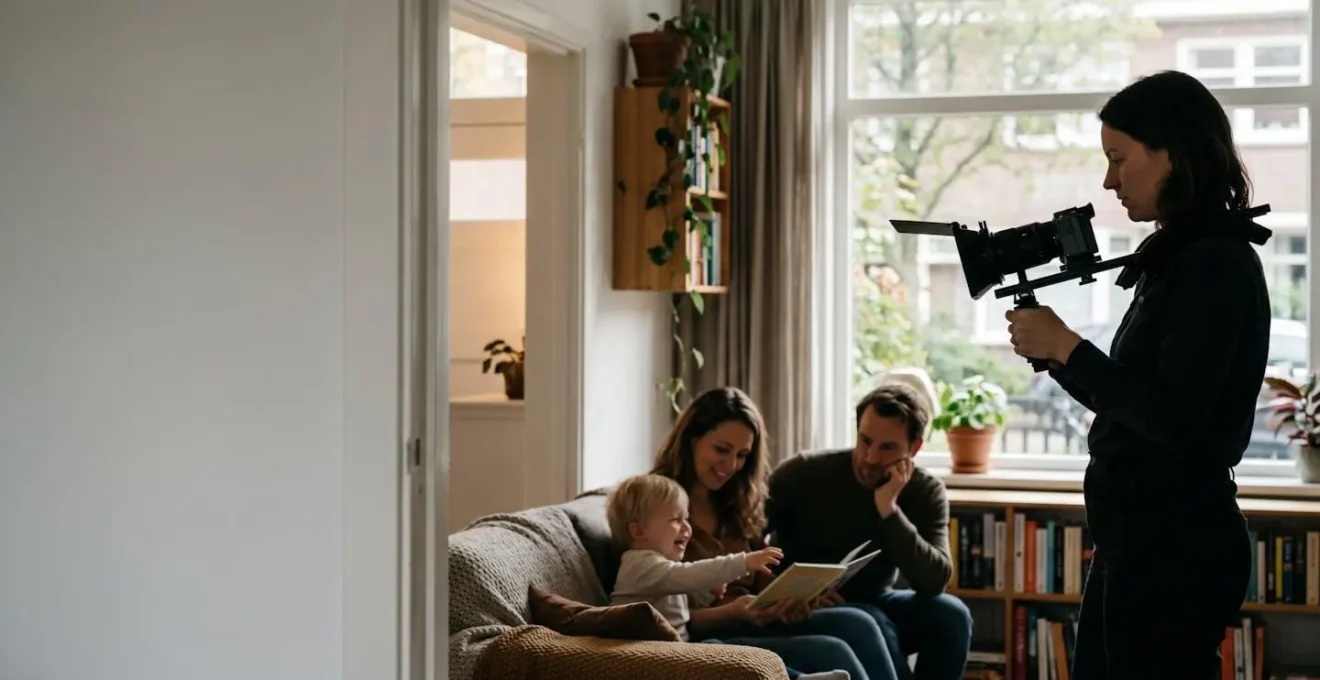
As the image above suggests, success lies in embracing the environment rather than fighting it. Using soft, natural light from a window avoids the harsh, alien presence of a lighting kit. The goal is to capture the scene as the family experiences it, not to impose a sterile, studio-like atmosphere. This requires a disciplined approach to equipment and placement, making conscious choices to prioritise invisibility over technical perfection. A slightly grainy shot that captures a moment of true connection is infinitely more valuable than a perfectly lit frame of stilted interaction.
Action Plan: Your Unobtrusive Filming Checklist
- Equipment Footprint Audit: Before entering the space, lay out every piece of gear. Is it essential? Can a smaller, more compact alternative be used? A single versatile lens is better than three primes that require disruptive changes.
- Natural Light Scouting: Arrive early to observe how light moves through the space. Identify the optimal position to use windows or existing lamps as your key light, minimising the need for any artificial setup.
- Camera Placement Strategy: Position the camera where it can cover the main action without panning or moving. Once it’s set, it becomes a static object, easier for the brain to ignore than a constantly moving operator.
- Audio Minimalism: Use small, discreet lavalier mics if necessary, but consider a well-placed boom or plant mic first. A visible microphone is a constant reminder of the recording process.
- Crew Containment: The crew should have a designated, out-of-the-way « base. » All movement should be slow and deliberate. The goal is to be boring, predictable, and ultimately, ignorable.
By following these principles, you shift from being an intruder to being just another part of the environment. The family doesn’t forget you’re there because you’ve charmed them; they forget you’re there because their brains have categorised you and your equipment as irrelevant to the immediate social task of having dinner together.
This technical discipline is the physical manifestation of the psychological principles discussed earlier. It is how you actively engineer the conditions for authenticity to flourish, even in the most sensitive of environments.
Should You Stop Filming to Intervene When Subjects Make Harmful Decisions?
This is perhaps the most profound ethical dilemma in observational filmmaking. You have spent weeks or months earning trust and achieving invisibility. You are now a steward of your subject’s story. But what happens when that story veers towards self-harm, danger, or a deeply regrettable choice? Does the imperative to observe override the impulse to help? There is no easy answer, and the filmmaking community itself is not monolithic in its view. Many, like acclaimed filmmaker Joe Berlinger, are acutely aware of the voyeuristic tightrope they walk.
I usually enter people’s lives at a time of crisis. If the tables were turned, God forbid, I would never allow them to make a film about my tragedy.
– Joe Berlinger, Honest Truths: Documentary Filmmakers on Ethical Challenges in Their Work
Berlinger’s words highlight the inherent power imbalance. The filmmaker, while « invisible, » holds immense power in deciding what to capture and how to frame it. This has led many professionals to move beyond rigid codes of conduct towards a more fluid model of « situational ethics. » It’s a recognition that every case is unique and requires a nuanced judgment call based on the specific relationship with the subject and the potential for real-world harm.
Case Study: The « Situational Ethics » Framework
A landmark 2009 study by the Center for Media and Social Impact revealed a consensus among documentarians that goes beyond simple non-intervention. Interviewing 45 filmmakers, the research found that most operate on a principle of ethical stewardship. They see themselves as caretakers of their subjects’ stories, a role that comes with responsibilities. Instead of a strict journalistic code, they make informal commitments and employ situational ethics, weighing their actions on a case-by-case basis. Critically, these filmmakers were deeply conscious of the power differential, recognising their prolonged presence (often a year or more) created a bond far different from the brief encounters of traditional journalism. This bond often informs the decision of when and how to intervene, if at all.
The decision to intervene is therefore not a simple choice between « filmmaker » and « human. » It’s a complex negotiation. Intervening can shatter the observational bubble and irrevocably alter the project. Not intervening can lead to profound personal and ethical regret, especially if harm occurs. The prevailing wisdom suggests that the line is often drawn at immediate, irreversible physical harm. A subject making a poor business decision is part of their story; a subject about to overdose or step into traffic may demand intervention. Ultimately, the filmmaker must define their own ethical boundaries before they are tested in a crisis.
This pre-emptive moral calculus is a non-negotiable part of the professional’s toolkit. It ensures that when a crisis hits, the response is based on considered principle, not panicked impulse.
The 3-Camera Observational Setup That Made Subjects Camera-Conscious for Weeks
In theory, a multi-camera setup for observational work sounds like a perfect solution: you get simultaneous coverage, multiple angles, and reduce the risk of missing a key reaction. In practice, however, it can be the single most destructive decision for achieving authenticity. A UK-based filmmaker recently recounted an experience where a three-camera setup on a new project made the subjects so intensely camera-conscious that it took weeks of single-camera work to repair the damage. The reason is simple: every additional camera multiplies the human and technical footprint, shattering the illusion of invisibility.
The problem isn’t just the physical presence of three cameras. It’s the tripling of everything else. Three operators mean three different eyelines for the subject to track, three moving bodies in their peripheral vision, and a constant, low-level hum of coordination. As multi-camera production research confirms, the larger crew and complexity create an environment that feels more like a professional television studio than an intimate, observational space. The subject is no longer in their own home; they are on a set.
This table clearly illustrates the trade-offs. The benefits of a multi-camera setup are geared towards controlled, repeatable, or live-broadcast environments, whereas the strengths of a single-camera approach are perfectly aligned with the goals of observational documentary.
| Aspect | Single-Camera Setup | Multi-Camera Setup |
|---|---|---|
| Crew Presence | Minimal footprint, 1-2 operators | Larger crew with multiple operators, technicians, directors |
| Subject Awareness | Single eyeline, easier to ignore | Multiple human eyelines creating constant awareness |
| Equipment Visibility | One camera position, becomes part of environment | Multiple positions requiring movement and communication |
| Setup Complexity | Quick setup, minimal disruption | Coordinating placement, avoiding crossed sightlines, managing timecodes |
| Spontaneous Moments | Risk of missing unscripted reactions | Better coverage but more intrusive presence |
| Best For | Observational documentary, intimate settings | Live events, unrepeatable action, talk shows |
The fundamental error is believing that more coverage equals a better story. For observational work, the quality of the moment trumps the quantity of angles. One truly authentic, unguarded interaction captured by a single, unobtrusive camera is worth more than hours of perfectly covered but sterile footage from a crew that made the subjects feel constantly watched.
The goal is to shrink your presence, not expand your technical capabilities. In the quest for authenticity, less is almost always more.
How to Stay Observational When Your Subject Experiences a Crisis on Camera?
Filming a subject during a crisis is the ultimate test of the observational filmmaker’s resolve. Every instinct may scream to lower the camera, to offer comfort, to engage as a human. Yet, the professional imperative is to keep rolling, to document the raw, unfiltered truth of the moment. The key to navigating this intense psychological space is to use the camera not as a shield, but as a professional buffer—a tool that creates the necessary emotional distance to continue working effectively and ethically.
The act of looking through the viewfinder, as depicted above, is a transformative one. It forces the brain to engage with the technical aspects of filmmaking: focus, framing, exposure. This technical concentration occupies cognitive bandwidth that might otherwise be overwhelmed by empathy or shock. It creates a small but crucial psychological gap, allowing the filmmaker to function as an observer of the scene rather than a participant in the trauma. This is not about being callous or unfeeling; it is a necessary professional mechanism for capturing moments of profound human experience without collapsing into them.
This act of professional detachment is deeply intertwined with the concept of stewardship. You are not just a passive recorder; you are entrusted with a person’s vulnerability. As the Center for Media and Social Impact’s research highlights, this is a role filmmakers take very seriously.
Many documentary filmmakers work with people whom they have chosen and typically see themselves as stewards of the subjects’ stories.
– Center for Media and Social Impact, Honest Truths: Documentary Filmmakers on Ethical Challenges
Being a good steward in a crisis means documenting the event with sensitivity and respect. It means holding the shot steady, capturing the nuance of the emotion, and trusting that the truth of the moment is powerful enough on its own. It’s also about knowing when the camera’s presence crosses a line from observation to exploitation. The decision to keep filming is a constant negotiation, but the camera itself can be the very tool that allows you to make that decision with a clear head, focused on the profound responsibility you hold.
In these moments, the camera becomes more than a recording device; it is a contract of professionalism between you and the story you are duty-bound to tell.
How to Spot Series That Value Character Change Over Shocking Plot Turns?
In a media landscape saturated with high-concept plots and shocking twists, it can be challenging to find series that prioritise the slow, patient work of character development. Yet, for an observational filmmaker, studying these narratives is essential. They offer a masterclass in how to build a compelling story from internal shifts rather than external events—the very essence of what observational documentary strives to capture. So, how can you identify these gems?
The first sign is a focus on consequences over catalysts. A plot-driven series is defined by its « what happens next » moments: the explosion, the betrayal, the sudden reveal. A character-driven series, by contrast, is more interested in « what happens *after*. » It lingers in the messy aftermath of a decision, exploring how an event changes a person’s worldview, their relationships, and their daily routines. The plot serves the character, not the other way around. Look for long scenes of dialogue after a major event, or quiet moments of solitary reflection. These are the spaces where true character change is revealed.
Secondly, pay attention to the nature of the conflict. Is the primary source of tension external (e.g., a villain to be defeated, a mystery to be solved) or internal (e.g., a moral compromise, a personal failing, a clash of deeply held values)? Series that value character change often feature protagonists whose greatest obstacle is themselves. Their journey is not about winning a fight, but about becoming a different person. Their « victory » might be a quiet moment of self-awareness or a difficult act of forgiveness. This is the kind of subtle, powerful material that authentic, observational footage is uniquely suited to capture.
Ultimately, these are the stories that resonate long after the final credits. They don’t just show us what happened; they reveal who we are. For a filmmaker dedicated to capturing authenticity, there is no more important lesson.
How to Stop Lighting and Camera Crew Disagreements Delaying Every Setup?
On-set friction between the camera department and the lighting crew is a tale as old as cinema itself. The director of photography wants to preserve the natural, atmospheric look, while the gaffer is tasked with ensuring a technically clean, well-lit image. In observational documentary, where speed and discretion are paramount, these disagreements can be disastrous, grinding production to a halt and drawing unwanted attention to the crew. The solution is not to find a perfect mediator, but to adopt a production philosophy that makes the debate irrelevant: radical minimalism.
The most effective way to eliminate crew disagreements is to eliminate the excess crew and equipment that fuel them. This « footprint discipline » is central to the work of many of the world’s most respected documentarians. As research on observational documentary techniques shows that the gold standard for a minimal crew is often just a camera operator and a sound recordist. This isn’t just about saving money; it’s a deliberate creative choice designed to maximise authenticity and agility.
Case Study: The Ken Burns « Lean Crew » Approach
Legendary filmmaker Ken Burns provides a powerful example of this philosophy in action. He intentionally works with a lean crew of just four people: himself, a cameraperson, an assistant, and a sound person. For most location shoots, they travel light with only the essential camera, tripod, and sound kit. Crucially, they rarely bring a lighting kit. This « traveling-light » methodology eliminates the very possibility of debates over lighting setups. It forces the team to work with the available natural light, making them faster, more adaptable, and significantly less obtrusive to their subjects. This lean approach is not a compromise; it is the core of their ability to react to unexpected opportunities and melt into the background.
By adopting a similar philosophy, you transform the dynamic on set. There are no departments to disagree because the crew is a single, unified entity with a shared goal. The question is no longer « How should we light this scene? » but « How can we capture this scene with what we have, right now? » This forces a creative, problem-solving mindset that prioritises the moment over technical perfection. It’s a shift from imposing a look onto a scene to discovering the look that is already there.
By making minimalism a non-negotiable principle from the outset, you don’t just prevent arguments; you create the conditions for a more agile, responsive, and ultimately more authentic form of filmmaking.
Key takeaways
- Embrace Cognitive Fatigue: Understand that subject authenticity arises when the brain is too tired to maintain a performance. The 48-hour rule is about reaching this point of mental saturation.
- Practice Footprint Discipline: The size of your crew and kit is directly proportional to your subjects’ self-consciousness. Every piece of gear and every crew member must justify its existence.
- Adopt Ethical Stewardship: Your role is not just to observe, but to be a responsible caretaker of your subject’s story, especially in moments of crisis. Define your ethical lines before they are tested.
How Can 6-Person Crews Finish Shoots 3 Hours Faster Through Better Coordination?
While the observational ideal is often a lean, minimal crew, the realities of production—especially for broadcast or larger-scale projects—can mandate a bigger team. A six-person crew can easily become a cumbersome, inefficient unit where departmental friction and poor communication lead to hours of wasted time. However, when managed with rigorous discipline and clear protocols, this larger team can leverage its size to become incredibly efficient. Indeed, production research demonstrates that multi-camera productions can be significantly faster by capturing different shots simultaneously.
The key to unlocking this efficiency is to shift the majority of the decision-making and coordination to the pre-production and pre-shoot phases. A well-run multi-camera shoot is like a choreographed ballet, where every member knows their moves long before the curtain rises. The chaos of on-set decision-making is replaced by the calm execution of a well-rehearsed plan. This front-loading of effort is what allows the team to move with speed and purpose once filming begins, capturing complex scenes in a fraction of the time it would take a single camera to get the necessary coverage.
This level of coordination doesn’t happen by chance. It requires implementing a strict operational protocol that governs everything from communication to camera placement. The goal is to transform a collection of individuals into a single, cohesive production unit.
- Conduct mandatory pre-shoot briefings: Before every major scene, the entire crew must gather. The director or DP walks through the shooting plan, shot lists, and potential challenges. This ensures everyone, from camera operators to the sound engineer, is working from the same script.
- Establish clear communication protocols: Use of headsets is non-negotiable. A clear chain of command for live direction prevents conflicting instructions. The director should be the single point of communication for cueing camera operators, ensuring movements are coordinated and capture the right emotional beats.
- Make real-time decisions for coverage: The director, watching multiple feeds, must be empowered to call out camera movements and angle adjustments on the fly, capturing the necessary coverage without needing to stop and reset for different shots.
- Coordinate technical setup meticulously: Before subjects arrive, camera positions must be locked to avoid crossed sightlines. Timecodes must be synced across all devices, and lighting and audio checks must confirm consistency across all camera feeds to simplify the post-production process.
By transforming on-set debates into pre-shoot planning, a six-person crew can overcome its inherent complexity and become a powerful tool for efficient, high-quality filmmaking. Implement these coordination strategies on your next shoot to reclaim hours lost to disorganisation.