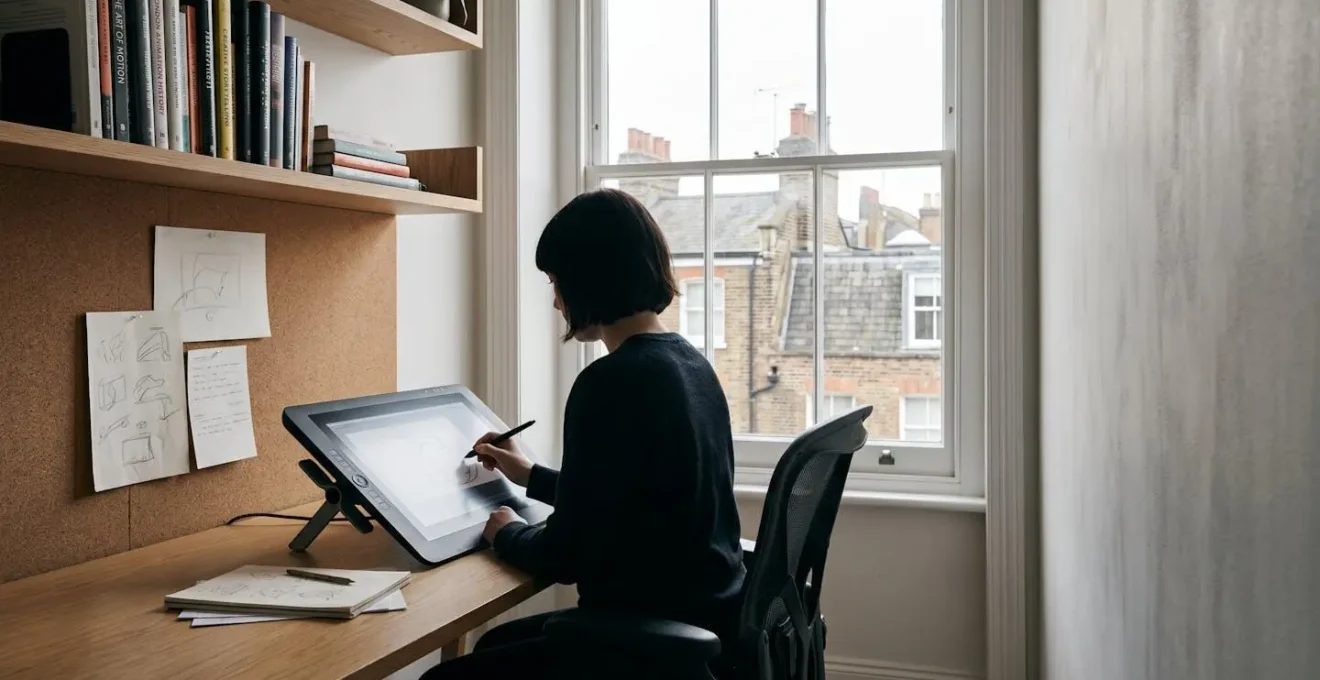
Thriving as a UK hand-drawn animator isn’t about working faster or cheaper; it’s about positioning smarter and protecting your craft with strategic business processes.
- Integrate « digital assists » to solve technical bottlenecks without sacrificing the hand-drawn aesthetic, significantly improving efficiency.
- Frame your service as a premium, « artisanal craft » to attract high-value clients and justify premium pricing, moving away from commodity comparisons.
Recommendation: Shift your mindset from a passionate artist to a creative entrepreneur by leveraging UK-specific funding and implementing rigorous planning to protect your time and creative control.
For any UK animator passionate about the tactile, expressive quality of hand-drawn animation, the landscape can feel daunting. The pressure to compete with the speed and scale of CGI production is immense, often leading to a perceived choice between creative compromise and financial instability. Many animators feel they are being priced out of a market that increasingly values speed over soul, forcing them to either abandon their craft for a studio CGI job or resign themselves to underpaid passion projects.
The common advice often misses the point. You’re told to simply « get faster » with digital tools or to « find a niche, » but this overlooks the core of the problem. Adopting digital tools without a strategy can dilute the very « hand-drawn » quality you seek to preserve, resulting in work that looks like budget CGI. And « finding a niche » is meaningless without a clear value proposition that clients can understand and are willing to pay for.
But what if the solution isn’t about becoming a faster, cheaper version of a CGI artist? What if, instead, the key is to operate like a Savile Row tailor in a world of fast fashion? The path to viability lies not in sacrificing craft, but in elevating it through workflow intelligence, strategic business positioning, and a deep understanding of the unique value hand-drawn animation offers. It’s about protecting the integrity of your work while ensuring its commercial sustainability.
This guide will navigate the practical strategies for achieving this balance. We will explore how to integrate digital assists without losing your artistic voice, how to position your work as a premium service, and how to leverage UK-specific funding to maintain creative and financial control. This is the blueprint for preserving the craft in a digital-dominated world.
To help you navigate these crucial strategies, we’ve broken down the key areas of focus. Explore the full table of contents to see how you can transform your passion into a sustainable and fulfilling career.
Summary: How UK Animators Can Master Artisanal Viability
- Why Do Hand-Drawn Films Feel More « Human » Than CGI to 70% of Viewers?
- How to Speed Up Hand-Drawn Animation by 40% Using Digital Assists?
- Solo Hand-Drawn Passion Project or Studio CGI Job: Which for Creative Fulfilment?
- The Style Confusion That Makes Hand-Drawn Look Like Budget CGI
- Should You Sell Hand-Drawn as « Artisanal Craft » or « Classic Nostalgia »?
- Why Does Adding 5 Planning Days Cut Total Project Time by 15 Days?
- How to Ensure Animators Deliver Serious Explainers Not Playful Cartoons?
- How Can Independent Animators Keep Creative Control with £30K Budgets?
Why Do Hand-Drawn Films Feel More « Human » Than CGI to 70% of Viewers?
The enduring appeal of hand-drawn animation lies in its inherent humanity. Unlike the mathematical perfection of computer-generated imagery, traditional animation carries the subtle imperfections and organic variations of the artist’s hand. Every slightly wavering line, every fractional difference in a repeated movement, and every textured brushstroke is a direct artefact of a human creator’s touch. This « perfect imperfection » is what audiences subconsciously connect with; it mirrors the organic, non-uniform nature of the real world and imbues characters and stories with a tangible soul.
This is not merely an artistic sentiment; it has proven commercial and critical value, particularly within the UK market which values heritage and craftsmanship. The success of projects that champion this aesthetic demonstrates a clear audience appetite for authentic, hand-crafted storytelling that stands in stark contrast to the often sterile feel of mainstream CGI.
Case Study: The Success of « Ethel & Ernest » in the UK
Raymond Briggs’ Ethel & Ernest (2016) is a prime example of hand-drawn animation’s power in the UK. Produced by Lupus Films with over 64,800 hand-drawn frames, the film was a significant success. It attracted 2.6 million viewers on its first BBC One broadcast and earned a 97% Rotten Tomatoes rating, with audiences and critics specifically praising its « human » quality and emotional authenticity. Backed by the BFI Film Fund, its success proved the business viability of large-scale hand-drawn projects for a UK domestic market that deeply values craftsmanship and heritage-based storytelling, showing it can be a distinct and profitable choice over CGI.
By embracing the unique qualities of the medium—the expressiveness, the texture, the artist’s visible hand—UK animators can offer something that CGI cannot easily replicate: a direct, emotional, and profoundly human connection with the audience. This isn’t a weakness to be overcome, but a core strength to be marketed.
How to Speed Up Hand-Drawn Animation by 40% Using Digital Assists?
The goal is not to replace hand-drawn artistry with digital tools, but to use « digital assists » strategically to remove production bottlenecks. This hybrid approach preserves the coveted hand-drawn aesthetic while making projects financially viable. By focusing digital power on the most time-consuming and technically difficult aspects of production, animators can reclaim hours for creative performance. In fact, industry case studies show that disciplined workflows can enable teams to trim 30-40% off production schedules, a critical saving for independent UK animators.
One of the most effective strategies is the « digital skeleton » technique. For scenes involving complex perspective shifts, product rotations, or architectural elements, creating a simple 3D blockout in a program like Blender provides a robust guide. This underlying 3D structure ensures perfect perspective and volume consistency, which you can then trace over with hand-drawn frames. This eliminates the painstaking process of manually calculating perspective, drastically reducing revision rounds from clients who spot inconsistencies.
The workflow extends into the animation and compositing stages. Drawing can be done frame-by-frame in software like TVPaint or Toon Boom Harmony, which offer digital in-betweening assists to speed up movement creation while maintaining a hand-drawn feel. These sequences are then imported into a compositing program like After Effects for final colour grading and effects. This pipeline allows a solo animator to tackle projects that were once the domain of larger teams, keeping budgets within the viable £5k-£15k range for UK SME clients and opening doors to larger commercial work by partnering with freelance 3D specialists for the technical setup.
Solo Hand-Drawn Passion Project or Studio CGI Job: Which for Creative Fulfilment?
For many UK animators, the career path seems to present a stark binary choice. On one hand, there is the allure of the large CGI studio job. These positions offer stability, the chance to work on high-profile projects, and participation in productions with significant financial backing. According to Animation UK, animated features in the UK can attract budgets in the ballpark of £15m-£100m, providing sustainable employment for large teams. However, this stability often comes at the cost of creative autonomy, with animators working as a small cog in a massive machine, executing a vision decided by others.
On the other end of the spectrum is the solo passion project. This path offers complete creative control—the freedom to tell your own stories in your own style. But it is a path fraught with financial precarity, isolation, and the immense challenge of managing every aspect of production, from fundraising to marketing, often for little to no pay. This dichotomy can leave animators feeling that they must sacrifice either their creative voice or their financial security.
However, a third model is emerging as a powerful alternative for UK animators: the indie collective production model. This approach combines the creative freedom of an independent project with the scale and resources of a collaborative enterprise.
Case Study: The « Ethel & Ernest » Collective Model
The production of Ethel & Ernest again serves as a powerful blueprint. Rather than being a solo endeavour or a single-studio production, Lupus Films built a distributed network of over 20 lead animators and assistants across London and Luxembourg. This collective model allowed them to pool specialist hand-drawn talent, share overheads, and successfully secure over £3m in funding from diverse sources like the BBC, BFI, and regional agencies. It demonstrates how UK animators can unite to win high-value projects while preserving the core artistic vision, offering a viable and fulfilling middle ground.
This collective approach allows animators to retain a high degree of creative control while accessing larger budgets and sharing the production burden, proving that it’s possible to achieve both creative fulfilment and professional viability without being forced into one of the two traditional, and often unsatisfying, extremes.
The Style Confusion That Makes Hand-Drawn Look Like Budget CGI
One of the greatest risks facing UK hand-drawn animators is a crisis of perception. When a project’s aesthetic is not clearly defined and communicated from the outset, clients may expect the fluid, vector-perfect look of digital animation. In trying to meet this misunderstood expectation, animators can over-smooth their lines and use tweening tools that strip the work of its hand-drawn character. The result is a visual product that lands in an uncanny valley: it lacks the organic charm of traditional animation and the polished perfection of high-end CGI, making it look like a « budget » version of the latter.
This style confusion is a commercial and artistic disaster. It devalues the very craft you are trying to sell and leads to endless, frustrating revision rounds with clients who « don’t know what they want, but know this isn’t it. » The solution is to seize control of the narrative before a single frame is drawn. This is achieved through a robust Animation Style Guide, which acts as a contract of vision between you and the client.
This document is not just a collection of pretty pictures; it is a strategic tool for managing expectations and protecting your process. It educates the client on the « why » behind your artistic choices and codifies the visual language of the project. By getting formal sign-off on the style guide, you create a shared understanding that prevents scope creep and ensures the final product aligns with the agreed-upon vision.
Your Action Plan: The Client Kickoff Style Guide
- Visual Style Definition: Curate 3-5 key frame examples that define the intended line quality, color palette, and level of detail. This provides a clear, un-arguable visual benchmark for the project’s aesthetic.
- Process Transparency Section: Include a short section explaining the « why » behind the hand-drawn choice. Use a relatable UK analogy, like comparing it to a Savile Row bespoke suit versus an off-the-rack one, to frame it as a premium, crafted service.
- Production Timeline Visualization: Provide a simple chart breaking down the project into pre-production (emphasize this is 30% of the time), animation, and post-production, with clear approval checkpoints marked to manage expectations.
- Technical Specifications: Clearly state the frame rate (e.g., 25fps for UK broadcast), resolution (1080p/4K), and final delivery formats. This prevents technical misunderstandings at the end of the project.
- Scripted Client Education: Prepare clear, concise answers to common questions. For example: « This is hand-crafted frame-by-frame animation, not a digital filter. Each drawing ensures the character’s performance is unique to your brand, creating a stronger emotional connection. »
Implementing a style guide transforms the client relationship from a reactive one to a proactive partnership, ensuring the unique value of your hand-drawn craft is understood, appreciated, and beautifully preserved in the final output.
Should You Sell Hand-Drawn as « Artisanal Craft » or « Classic Nostalgia »?
How you position your hand-drawn animation in the UK market directly impacts the clients you attract, the price you can command, and the funding you can access. Simply stating that you do « hand-drawn animation » is not enough. You must frame your service with a strategic narrative. The two most powerful commercial angles are « Artisanal Craft » and « Classic Nostalgia, » but a third, « Cultural Heritage, » unlocks access to public funding.
The Artisanal Craft angle positions your work as a bespoke, premium service. This resonates strongly with ethical startups, craft breweries, luxury goods, and artisan food producers—brands built on authenticity and quality. The key message is that every frame is hand-crafted, a unique creation that embodies the client’s brand values. This narrative justifies premium pricing and can even lead to additional deliverables, like « making-of » content for the client’s social media, further demonstrating the value.
The Classic Nostalgia angle, by contrast, taps into a powerful emotional reservoir. It appeals to established brands targeting Gen X and Millennial audiences, as well as heritage organizations. By evoking the memory of beloved classics like The Snowman or vintage BBC animations, you offer a timeless aesthetic that cuts through the noise of fleeting digital trends. This is a powerful differentiator for brands in oversaturated markets.
Finally, the Cultural Heritage angle is a strategic key for unlocking non-commercial funding. By framing your project as a preservation of traditional British animation craft, you can meet the criteria for public funding bodies. To qualify for crucial tax benefits, such as those under the UK Government’s AVEC scheme, projects must pass a Cultural Test. Hitting the required points (16+ for TV, 18+ for features) can be the difference between a project being viable or not, and the financial benefits are significant. A key part of this is that the UK Government’s AVEC scheme offers a net value of 29.25% from January 2024 on qualifying expenditure.
The following matrix breaks down how to apply these strategies to different UK client sectors.
| Positioning Angle | Target UK Client Sectors | Key Messaging Points | Funding/Revenue Strategy |
|---|---|---|---|
| Artisanal Craft | Ethical startups, craft breweries, luxury goods, artisan food/drink producers (e.g., British heritage brands) | Emphasize bespoke quality, every frame hand-crafted, transparency of process, alignment with brand authenticity values | Premium pricing justified by craftsmanship narrative; potential for ‘making-of’ content as additional deliverable for client social media |
| Classic Nostalgia | Established brands targeting Gen X/Millennials, heritage organizations (The National Trust), legacy media companies | Evoke emotional connection to childhood animation memories (The Snowman, classic BBC animations), timeless aesthetic that transcends digital trends | Mid-range pricing; appeals to brands seeking differentiation in oversaturated digital markets |
| Cultural Heritage (Funding Angle) | Museum projects, educational institutions, public sector campaigns, documentary/biographical subjects | Frame project as preserving traditional British animation craft; demonstrate cultural value and skills transmission | Access Arts Council England, National Lottery Heritage Fund, BFI Cultural Test points (16+ out of 31 for animation TV, 18+ out of 35 for features) |
Choosing the right positioning isn’t just a marketing decision; it’s a fundamental business strategy that defines your place in the UK’s creative economy.
Why Does Adding 5 Planning Days Cut Total Project Time by 15 Days?
It sounds counterintuitive, but the single most effective way to shorten an animation project’s timeline is to lengthen the pre-production phase. For a UK animator, time is money, and the most costly part of any project is re-animation caused by client changes late in the process. Investing an extra week in meticulous planning can save three weeks or more of expensive, soul-crushing rework down the line. Production efficiency data from UK animation studios shows up to a 25% drop in revisions and 30-40% faster production when workflow stages are clearly defined.
The key to this efficiency is the « Animatic-as-Contract » method. This transforms the animatic from a rough guide into a legally binding creative lock-off. By investing those extra planning days, you create a detailed animatic complete with a locked audio track, precise timing, and key character poses. This becomes the definitive blueprint for the animation. You then present this to the client for formal sign-off, with a clause in your contract stating that animation production will not begin until this approval is received.
This method provides crucial protection for the animator. Your contract should specify that any changes requested after animatic approval will be treated as out-of-scope and will trigger additional charges at a day rate. This simple mechanism forces clients and their stakeholders to consolidate their feedback and make decisions early, when changes are cheap. It prevents the dreaded « death by a thousand cuts » from multiple departments offering contradictory feedback after animation has already begun. For UK SME clients who may not understand the animation process, it’s vital to quantify this value. You can provide a simple cost calculator showing how a £50/hour investment in planning prevents £2,000-£5,000 in re-animation costs later, turning an abstract concept into a concrete financial argument they can appreciate.
This rigorous front-loading of decision-making doesn’t stifle creativity; it protects it. By establishing a solid, agreed-upon foundation, you create a secure space in which to execute your craft, free from the constant threat of late-stage changes that derail timelines and destroy budgets.
How to Ensure Animators Deliver Serious Explainers Not Playful Cartoons?
A common challenge for hand-drawn animators working with corporate clients in sectors like finance, healthcare, or public policy is the fear that animation will look too « childish » or « playful. » Clients want the clarity and engagement of animation but worry it will undermine the gravitas of their message. The animator’s task is to use the visual language—the semiotics—of animation to communicate « serious, » « authoritative, » and « professional. »
This is not about the technique itself, but the stylistic choices applied to it. Successful UK-based educational content producers like The Economist and The School of Life have pioneered a visual standard for serious explainers. Their approach consciously avoids the tropes of entertainment animation. Instead of vibrant, multi-coloured character-driven narratives, they use a deliberately limited colour palette (often two or three corporate colours plus neutrals), abstract geometric forms to represent complex ideas, and precise kinetic typography for data visualization. The pacing is also key: slower, more deliberate transitions and longer holds on key information convey a sense of authority and allow the viewer to absorb the content.
This approach borrows its principles from information design and architectural drawing rather than classic cartooning. By focusing on clarity, structure, and a restrained aesthetic, the hand-drawn quality adds a layer of sophisticated craftsmanship rather than playful energy. It communicates that every frame has been thoughtfully constructed to convey information with maximum efficiency and minimal distraction.
Case Study: Best Practices from UK Serious Explainer Studios
Studios like Educational Voice in Belfast apply these principles rigorously for their corporate clients. They adhere to the 25fps UK broadcast standard, use minimal motion blur to maintain crispness, and employ compositions that guide the eye through information logically. This visual discipline allows them to leverage the unique appeal of hand-drawn textures and lines while ensuring the final product feels like a high-end business communication tool, perfectly suited for a public sector campaign or a financial services explainer video.
By mastering this distinct visual language, UK animators can confidently pitch to serious corporate clients, reassuring them that their hand-drawn explainer will be perceived as an intelligent, sophisticated piece of communication, not a Saturday morning cartoon.
Key takeaways
- Adopt a hybrid workflow, using « digital assists » to speed up technical tasks while preserving the core hand-drawn aesthetic.
- Position your service strategically as either « Artisanal Craft » or « Classic Nostalgia » to attract the right UK clients and justify premium pricing.
- Implement the « Animatic-as-Contract » method to protect your time, budget, and creative vision from late-stage client changes.
How Can Independent Animators Keep Creative Control with £30K Budgets?
For independent animators in the UK, a £30,000 budget represents a significant opportunity, but it also carries the risk of ceding creative control to a single, dominant investor. The key to maximizing both the budget and your artistic freedom lies in understanding and strategically leveraging the UK’s unique ecosystem of tax relief and match funding. This isn’t just about finding money; it’s about building a financial structure that empowers your vision.
The cornerstone of this strategy is the Audio Visual Expenditure Credit (AVEC). This is not a grant, but a cash rebate on your qualifying UK production costs. As the A+C Studios production guide demonstrates, under this scheme, if you spend £1,000,000 on qualifying animation costs in the UK, you could receive approximately £292,500 back. On a smaller £30k project with £25k of qualifying UK spend, the 29.25% AVEC claim translates to approximately £7,312. This recovered amount is a game-changer; it becomes a financial buffer that you control, allowing for an extra animation pass, a professional sound mix, or a festival submission campaign without going back to an investor.
To access this, you must operate correctly. This involves setting up a UK Limited Company as a Special Purpose Vehicle (SPV) before production starts and ensuring your project passes the BFI’s Cultural Test by scoring a minimum of 16 points (for TV) or 18 points (for features). This is achieved by strategically planning your production to use UK-based talent and facilities.
The second pillar is match funding. Instead of seeking £30k from one source, aim to secure a £15k commercial commission first. This initial investment acts as powerful leverage. You can then approach funding bodies like the BFI Short Form Animation Fund, Screen Scotland, Ffilm Cymru Wales, or Arts Council England and present your £15k as 50% match funding. These bodies are far more likely to invest in a project that already has commercial backing. This strategy effectively doubles your budget to £30k without handing over complete control to a single large investor. You maintain a balanced power dynamic and protect your creative vision by diversifying your funding sources.
Ultimately, the path to a sustainable career in hand-drawn animation is not about abandoning the craft but about arming it with business acumen. By embracing these strategies, you can shift from feeling priced out to being sought after for your unique, high-value, and professionally managed creative service. Start today by evaluating your own workflow and client communication; the first step to being treated like a master craftsman is to act like one.