The effectiveness of a re-enactment rests not on its budget, but on its honesty with the audience.
- Violating the viewer’s trust with unlabelled reconstructions is the fastest way to undermine your film’s credibility.
- Authenticity is achievable on a small budget by focusing on ‘hero details’ and leveraging community resources, not by recreating entire expensive scenes.
Recommendation: Treat every re-enactment as a transparent negotiation with your audience, consciously choosing a visual style that signals your intent—from forensic realism to emotional impressionism.
As a UK documentary maker, you understand the fundamental tension: how do you visualise a past that was never filmed? The temptation is to turn to re-enactments, yet the fear is that they will instantly brand your work as cheap, manipulative, or, worst of all, untruthful. The landscape is littered with examples of « dramatisations » that pull viewers out of the story and shatter the fragile trust you’ve worked so hard to build. You want to bring history to life, not reduce it to a low-budget costume drama.
The common advice is often simplistic: just label it « re-enactment, » use a dreamy soft-focus, and hope for the best. But this approach ignores the sophisticated visual literacy of modern audiences. They can feel the difference between an authentic visualisation and a disingenuous shortcut. The real challenge lies in navigating the ethical tightrope between factual accuracy and narrative power. It’s not about whether to use re-enactments, but *how* to deploy them as a tool of clarification rather than a crutch of fabrication.
This guide moves beyond the platitudes. The key isn’t to perfectly fool the viewer into believing they’re watching archive footage. Instead, the most powerful re-enactments function as a transparent negotiation of truth with the audience. Their success lies in consciously choosing the right level of authenticity—from forensic detail to emotional impressionism—and signalling that choice clearly. This is about protecting your integrity by making the viewer a partner in the reconstruction of truth, not a victim of its distortion.
Throughout this guide, we will dissect the strategies that separate powerful, truth-enhancing reconstructions from the cheap dramatisations that compromise documentary credibility. We will explore the psychology of viewer trust, budget-conscious methods for achieving period accuracy, the strategic use of visual style, and the ethical lines you must not cross.
Summary: A Strategic Framework for Authentic Re-Enactments
- Why Do Viewers Forgive Labelled Re-Enactments but Reject Secret Ones?
- How to Verify Period Details for Re-Enactments on £2K Per Scene Budgets?
- Soft-Focus Reconstruction or Crisp Realism: Which Visual Style for Re-Enactments?
- The Speculative Re-Enactment That Undermines Your Documentary’s Factual Claims
- Should You Re-Enact the Historical Event or Let Still Images Tell the Story?
- Why Do Hand-Drawn Films Feel More « Human » Than CGI to 70% of Viewers?
- How to Tell 1940s Stories When Archive Clips Cost More Than Your Entire Budget?
- How Can UK Filmmakers Access Archive Footage Without £5K Per Clip Fees?
Why Do Viewers Forgive Labelled Re-Enactments but Reject Secret Ones?
The core of the issue lies in an unspoken agreement between the filmmaker and the audience, often called the « documentary contract. » Viewers approach non-fiction with a default assumption of authenticity. They trust that you are presenting them with reality as it was recorded. When you seamlessly blend a staged scene with genuine archive footage without any signal, you are breaching this contract. This is not a matter of artistic license; it is a fundamental violation of trust.
The International Documentary Association frames this responsibility perfectly, stating that the challenge is one of « anticipating an audience that will assume authenticity, unless told otherwise. » For decades, a clear visual language has been developed to manage this contract. An analysis of documentary standards notes that filmmakers established conventions, such as using blurry or dreamy aesthetics for staged scenes, to signal the shift from objective footage to a subjective or constructed visualisation. On-screen text labels, shifts in film stock, or changes in sound design all serve the same purpose: they are acts of transparency that respect the viewer’s intelligence.
Case Study: The Jonestown Documentary Re-enactment Controversy
The A&E Network documentary ‘Jonestown: The Women Behind the Massacre’ provided a cautionary tale. It seamlessly merged re-enacted events with actual footage without differentiation, leaving viewers struggling to distinguish reality from reconstruction. This approach didn’t just blur a line; it erased it, causing audiences to implicitly trust potentially misleading content. The backlash highlighted how unlabelled re-enactments breach the documentary contract, destroying credibility and risking the spread of historical misinformation.
When you explicitly label a re-enactment, you are not admitting weakness. You are re-negotiating the contract in good faith. You are saying, « This event happened, but we have no footage. To help you understand it, we have reconstructed it based on our research. » This honesty is what viewers forgive. They reject the deception, not the technique itself. The integrity threshold is crossed the moment you prioritise a seamless illusion over transparent truth.
How to Verify Period Details for Re-Enactments on £2K Per Scene Budgets?
Maintaining authenticity doesn’t require a Hollywood budget. For a UK filmmaker working with modest funding, the key is strategic allocation and meticulous research, not lavish set dressing. The perception of authenticity is often created by a few, well-chosen details rather than a complete, historically perfect environment. On a budget of around £2,000 per scene, your focus must shift from breadth to depth.
The principle is to invest in what the audience—and the camera—will scrutinise most closely. This means prioritising ‘contact items’: props that a subject directly touches, wears, or uses. A period-correct fountain pen in a close-up, the specific fabric of a uniform, or the right brand of cigarettes can sell the entire scene. Your audience’s brain will project this concentrated authenticity onto the less-detailed elements in the background. Free digital resources are your greatest asset here. Extensive archives of old mail-order catalogues, magazine advertisements, and digitised family photos on genealogy sites provide invaluable, no-cost visual references for clothing, products, and domestic life.
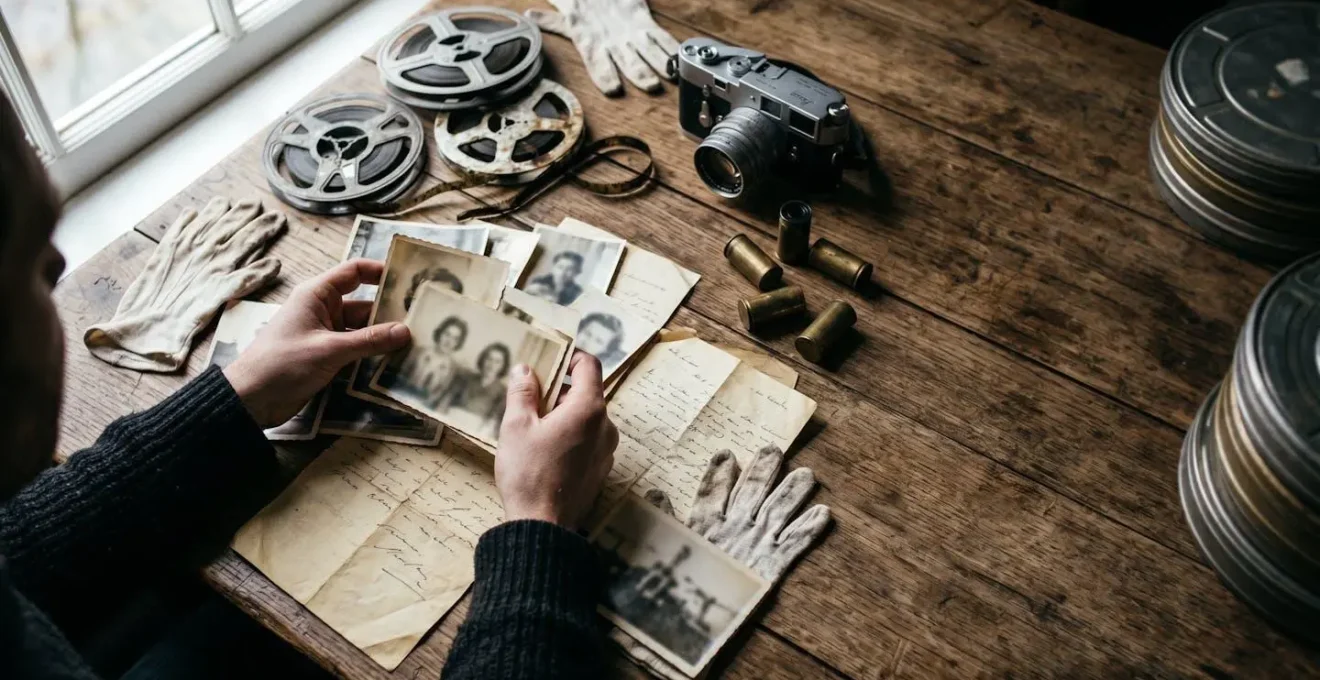
As the image above demonstrates, focusing on the tactile reality of materials—the worn leather, the tarnished brass, the aged paper—can create a powerful sense of historical presence. Furthermore, you should actively partner with those who have already done the work. Local historical societies, vintage car clubs, and dedicated military re-enactor groups often possess a wealth of knowledge and props. Many are willing to provide expertise or lend items for a simple screen credit or a small donation, saving you thousands in rental and consultant fees. The goal is to build a convincing world through a few hyper-accurate ‘hero details’ that anchor the viewer in the time period.
Soft-Focus Reconstruction or Crisp Realism: Which Visual Style for Re-Enactments?
The choice of visual style for a re-enactment is not merely aesthetic; it’s a declaration of intent. The clichéd, slow-motion, soft-focus look has become a lazy shorthand, often used without considering its meaning. This style signals memory, subjectivity, and distance from the event. It can be effective for conveying emotional truth or a fragmented recollection, but it’s not the only option. The alternative, a crisp and realistically lit « forensic realism, » makes a very different claim. It suggests objectivity, evidence, and a desire to show events as they might have physically occurred.
Neither style is inherently superior. The correct choice depends entirely on what kind of truth you are trying to communicate. Are you reconstructing the subjective, traumatic memory of a witness? Then a more impressionistic, even surreal, style might be more « truthful » to their experience. Are you demonstrating the mechanics of a crime based on forensic reports? Then a clean, clear, and objective visual approach is required. The danger lies in a mismatch: using a dreamy style to present a disputed fact as an emotional truth can be deeply manipulative.
Case Study: The Act of Killing’s Genre-Fluid Re-enactments
Joshua Oppenheimer’s groundbreaking film had Indonesian death squad leaders recreate their mass-killings in the style of their favourite movies—musicals, westerns, and film noir. This radical approach never risked being mistaken for reality. Instead, the hyper-stylised, often bizarre re-enactments served a deeper psychological purpose. According to one scholar, the approach gave the film a « fever-dream quality, » revealing profound truths about the perpetrators’ self-mythology and the way they sanitised their own atrocities. The constant shifting of visual styles was the ultimate form of honesty about the subjective and constructed nature of the scenes.
Filmmaker Joshua Oppenheimer himself articulated this powerful idea when he said, « Sometimes making fantasy is the most documentary thing you can do. » By embracing a non-realistic style, he avoided any pretence of showing objective reality, instead using the artificiality of genre to expose a more profound, psychological truth. Your choice of style is a critical part of the negotiation with your audience, telling them what kind of information—emotional or factual—you are offering.
The Speculative Re-Enactment That Undermines Your Documentary’s Factual Claims
The most dangerous territory in documentary filmmaking is the speculative re-enactment—visualising an event for which there are no witnesses and no definitive evidence. This is where the integrity threshold is most fragile. When you present a single, definitive version of an unknown event, you are no longer documenting; you are fictionalising. This act can irrevocably damage your credibility and the factual claims of your entire film.
As the legendary documentarian Errol Morris said, « Some reenactments serve the truth, others subvert it. » The difference lies in transparency about the speculation itself. New industry guidelines are moving towards radical transparency. For example, new best practices announced in 2024 now require on-screen disclosure for any enhancement techniques, however minor. The ethical way to handle speculation is to make the uncertainty the subject of the re-enactment, rather than hiding it.
Case Study: The Thin Blue Line’s Ethical Speculation
Errol Morris’s 1988 masterpiece, ‘The Thin Blue Line’, is the textbook example of how to handle conflicting accounts. To investigate a wrongful murder conviction, Morris employed multiple, contradictory re-enactments of the crime. Each version was based on a different witness testimony. By staging the same event in conflicting ways—one from the accused’s perspective, another from a questionable witness—he didn’t claim to know the truth. Instead, he used the re-enactments to demonstrate the unreliability of memory and testimony. The speculation itself became the evidence, a technique that ultimately helped exonerate an innocent man.
If you must speculate, you must signal it. This can be done by presenting multiple conflicting versions, as Morris did. It can also be achieved through visual cues: using schematic animations, showing only partial details, or using a deliberately artificial style that prevents the viewer from accepting the scene as literal fact. The guiding principle is to visualise the question, not the answer. A re-enactment that presents a theory as fact is a lie; a re-enactment that explores multiple theories as possibilities is a form of investigation.
Should You Re-Enact the Historical Event or Let Still Images Tell the Story?
The decision to commission a re-enactment versus relying on the classic Ken Burns effect on still photographs is a significant one. While stills combined with narration can be powerful, they often lack the dynamic energy to convey the chaos, emotion, or mechanics of a complex event. Re-enactments, despite their risks, offer a way to inject life and clarity into a narrative that might otherwise feel static or purely academic. Their use is not a modern fad; research on documentary techniques shows that the use of re-enactments has become one of the leading hybrid forms in the genre, evolving since the earliest days of cinema.
The primary justification for re-enactment is often one of necessity. As Academy Award-winning filmmaker Allie Light points out, there is a simple reason for their use:
A good reason for doing reenactments is that the past lives of most people are not documented, so very little material exists to tell the story.
– Allie Light, Interview on documentary reenactment techniques
This is particularly true when telling the stories of marginalised communities, private family histories, or events that occurred before portable cameras were commonplace. Stills can show you faces and places, but they cannot show you process, interaction, or the sequence of an action. A re-enactment can carefully reconstruct the steps of a forgotten craft, the frantic moments of a rescue, or the subtle social dynamics of a historical meeting in a way that static images simply cannot. The key is to ensure the re-enactment is adding new information or clarity, not just decorating a voice-over.
However, the choice is not always binary. Often, the most effective approach is a hybrid one. A sequence might begin with authentic still photographs to establish the real faces and locations, then transition into a carefully signalled re-enactment to explain a crucial action, before returning to a photograph of the aftermath. This method grounds the reconstruction in historical reality while using the re-enactment’s strengths for a specific narrative purpose. The re-enactment should always serve the story, filling a specific gap that stills or narration alone cannot bridge effectively.
Why Do Hand-Drawn Films Feel More « Human » Than CGI to 70% of Viewers?
When live-action re-enactment feels too fraught with ethical risk or is simply impossible, animation offers a powerful and surprisingly honest alternative. Hand-drawn animation, in particular, has a unique ability to connect with viewers on an emotional level. The perceived « imperfections »—the slight wobble of a line, the organic texture—signal the presence of a human hand. This visible artistry fosters a different kind of trust. The audience knows they are not looking at reality, and this very artificiality becomes a form of radical honesty.
This connection is not just anecdotal. Research on moving images and human perception confirms that hand-drawn animation still attracts a considerable audience and is often valued for its sophisticated capacity to express human emotions and senses. Unlike photorealistic CGI, which can fall into the « uncanny valley » and feel sterile or unsettling, traditional animation immediately declares its constructed nature. This allows filmmakers to explore highly subjective or traumatic material without being exploitative. It can visualise memories, dreams, and psychological states in a way that live-action simply cannot without feeling manipulative.
The process itself, as seen above, is one of human craft. This inherent humanity is what allows animation to be the perfect vehicle for stories of memory and trauma, which are by nature fragmented, subjective, and non-literal.
Case Study: Waltz with Bashir’s Animation as Honest Re-enactment
Ari Folman’s 2008 documentary ‘Waltz with Bashir’ used stark, hand-drawn animation to reconstruct a soldier’s suppressed memories of the 1982 Lebanon War. As an academic analysis of the film notes, the animation technique automatically fulfilled the ‘documentary contract’ by never pretending to be literal reality. This allowed for an unflinching exploration of subjective trauma and the fallibility of memory. A live-action re-enactment of these horrific events would have felt exploitative and dishonest. The visible artificiality of the animation became the ultimate form of truthfulness about representing incomplete and traumatic recollections.
For a documentarian, animation is not a lesser option; it is a sophisticated tool for representing a different kind of truth. When the story is internal, psychological, or remembered, the honest artifice of animation can be more powerful and more ethical than any live-action reconstruction.
How to Tell 1940s Stories When Archive Clips Cost More Than Your Entire Budget?
The prohibitive cost of archive footage is one of the greatest barriers for independent filmmakers. When telling stories from a period like the 1940s, a single minute of high-quality newsreel footage can consume your entire production budget. However, a lack of funds does not mean a lack of historical storytelling. It demands a shift in creative strategy, moving from direct illustration to more evocative and impressionistic techniques.
Instead of showing, you can suggest. Sound design is your most powerful and cost-effective tool. The sound of a period-specific air-raid siren, the crackle of a valve radio broadcasting a Neville Chamberlain speech, or the rumble of a steam train can instantly transport an audience. Layering these authentic sounds over beautifully shot close-ups of a protagonist’s face, or even over a black screen, can be more emotionally resonant than a grainy, expensive clip of a generic crowd. This approach allows the viewer’s imagination to do the work, creating a more personal and immersive experience.
Another powerful technique is the use of ephemera. Instead of footage of an event, show the documents it generated. A slow pan across a ration book, a close-up on a telegram bearing bad news, or a lovingly preserved letter from the front line can tell a deeply personal story. These artifacts are the tangible proof of life from the period. When combined with a compelling voice-over from a real diary or letter, they create a potent form of documentary storytelling that is both intimate and historically grounded. This method turns a budgetary constraint into an aesthetic strength, focusing the narrative on the human scale of history.
Finally, consider using re-enactments not to show the grand event, but the small, human moments within it. You may not be able to afford to stage a VE Day street party, but you can afford to re-enact a single family listening to the news in their living room, their faces illuminated by the wireless set. This focus on the micro-narrative is often more compelling and is entirely achievable on a tight budget.
Key takeaways
- The foundation of all documentary work is the ‘documentary contract’—the audience’s trust that you are presenting reality unless clearly signalled otherwise.
- Authenticity on a budget is achieved through ‘hero details’ (period-correct contact items) and leveraging free resources, not by attempting full-scale recreations.
- The visual style of a re-enactment is a declaration of intent; it must match the type of truth (factual or emotional) you are communicating.
How Can UK Filmmakers Access Archive Footage Without £5K Per Clip Fees?
While creative workarounds are essential, sometimes a project genuinely needs authentic moving images from the period. For UK filmmakers, the eye-watering fees from major commercial archives—where rates can start at around £40 per second with a minimum license of over £430—can seem insurmountable. However, a vast ecosystem of low-cost and free footage exists for those who know where to look and how to navigate the legal frameworks.
The first port of call should always be the public domain. Archives like the Prelinger Archives and Archive.org host thousands of « ephemeral films »—industrial, educational, and amateur home movies—that are free to use. Searching with specific terms like ‘home movies 1940s England’ or ‘Ministry of Information film’ can unearth unique visuals unavailable in commercial libraries. Beyond the public domain, it is crucial for UK filmmakers to have a working knowledge of the ‘fair dealing’ doctrine. This provision in UK copyright law allows for limited use of copyrighted material without payment for purposes of criticism, review, or news reporting. Using a short, transformative clip to comment on it is far more defensible than lifting a long segment for atmosphere. While this requires careful judgment and often legal advice, it is a powerful tool.
To truly unlock budget-friendly archives, you must think beyond the obvious sources. University special collections, local TV station archives, and even the archives of defunct companies can be goldmines of inexpensive or even free footage. Projects like the Center for Home Movies are dedicated to preserving and sharing these very personal histories. A strategic and persistent research process is your best investment.
Your Action Plan: Strategic Archive Access on a Budget
- Maximise public domain: Start with Prelinger Archives and Archive.org, using specific search terms (‘home movies 1940s’, ‘ephemeral films’) to find hidden gems.
- Understand fair dealing: Consult the principles of the UK’s fair dealing doctrine for criticism or commentary, but always seek legal counsel for your specific project’s use case.
- Target niche archives: Look beyond major libraries to university collections, local TV stations, and collaborative projects like the Center for Home Movies, which often have lower fees.
- Master Creative Commons: Systematically use CC license filters on platforms like YouTube and Vimeo to find footage that can be used legally, often just for attribution.
- Negotiate strategically: When licensing, negotiate for limited rights (e.g., UK broadcast only, festival circuit only) rather than expensive worldwide, all-media rights.
By combining these search strategies with savvy negotiation and a solid understanding of fair dealing, you can build a rich visual tapestry for your film without bankrupting the production. It requires more effort than a simple call to a major archive, but the reward is often more unique and authentic footage that sets your film apart.
To secure the integrity of your next project, begin by auditing your narrative choices against these principles of transparency and authenticity. Your credibility as a filmmaker depends on it.