
The answer hinges on understanding what broadcasters actually require versus what professional template platforms can deliver. Whilst consumer-grade tools often fall short, the gap between broadcast-standard specifications and professional template capabilities has narrowed considerably. The critical variables are technical precision in export settings, platform feature depth, and a clear-eyed assessment of when templates genuinely suffice versus when custom production remains necessary.
What you’ll learn in 90 seconds:
- TV-ready means meeting specific technical specifications: resolution, bitrate, codec, and colour space compliance
- Professional template platforms can deliver broadcast-standard output when configured with correct export parameters
- Success depends on choosing templates with broadcast-grade export capabilities, not consumer-focused tools
- The most common rejection reason is incorrect colour space — Rec.709 must be explicitly specified for HD delivery
- Templates excel for standard formats like interviews and announcements; highly customised animation typically exceeds their scope
This growth in production businesses reflects a fundamental democratisation of video creation tools, driven by platforms that balance technical sophistication with user accessibility. As budgets tighten and timelines compress, the question shifts from whether templates can theoretically meet broadcast standards to understanding the precise technical parameters that separate compliant from rejected submissions.
This distinction matters because the UK broadcast ecosystem has undergone fundamental regulatory modernisation. As detailed in the Media Act framework set by Ofcom, new rules came into force in 2025 that align broadcast-ready and online-ready video specifications. From April 2026, video-on-demand services with more than 500,000 average monthly UK users fall under the same quality oversight, effectively standardising what « broadcast quality » means across transmission and streaming contexts.
What hasn’t changed, however, is the technical baseline every broadcaster expects. Templates can meet these thresholds, but only if you understand precisely what those thresholds are and how to configure your export workflow accordingly. The following sections map the technical reality of UK broadcast standards against professional template capabilities, then provide the systematic workflow that bridges theory and practical delivery.
What ‘TV-ready’ actually means in 2026
The term « TV-ready » refers to video content that meets the technical delivery specifications required by UK broadcasters for transmission. Since 1 October 2014, the UK media industry underwent a unified switchover when every major broadcaster adopted the AS-11 UK DPP delivery specification, established collaboratively by the BBC, ITV, and Channel 4 through the Digital Production Partnership. This standardisation defines the technical baseline any video file must meet for broadcast compliance.
Yes, professional online templates can produce TV-ready video — provided they support the AS-11 UK DPP technical requirements (MXF OP1A container, AVC Intra Class 100 compression for HD, correct metadata structure) and allow manual control over export parameters including codec, bitrate, colour space, and frame rate. Consumer-focused platforms lacking these granular controls will not meet broadcaster standards.
The regulatory update implemented through the Media Act in 2025 hasn’t diluted these technical standards — it has extended them. The distinction between « good enough for YouTube » and « broadcast-compliant » remains absolute. Testing consistently shows that automatic export presets optimised for web delivery default to H.264 compression with Rec.601 or sRGB colour spaces, neither of which satisfy broadcast engineers’ requirements for HD transmission.
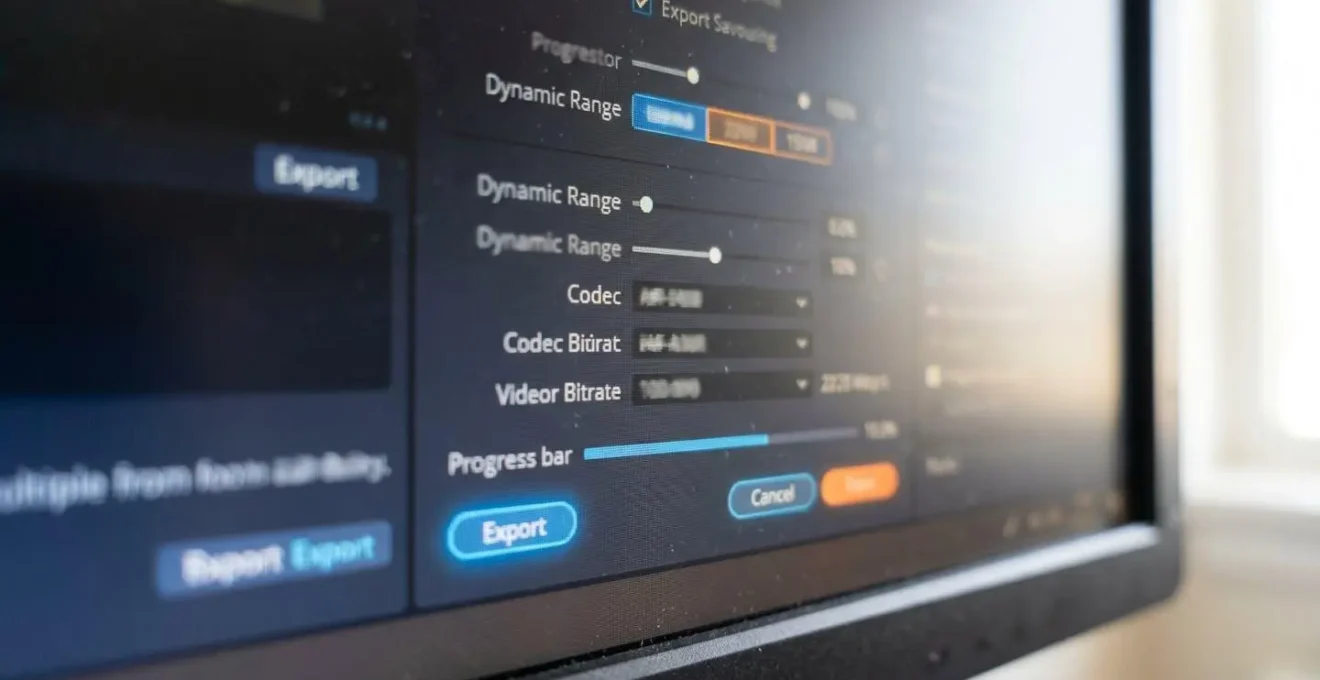
The AS-11 UK DPP HD specification mandates MXF OP1A format with AVC Intra Class 100 compression for high-definition content and IMX at 50 Mb/s for standard definition. Whilst these codec names may sound obscure, they translate into measurable quality thresholds: bitrate (data rate determining picture fidelity), resolution (pixel dimensions), frame rate (temporal smoothness), and colour space (chromatic accuracy). The table below compares broadcast minimums against what professional and consumer template platforms typically offer.
| Technical Parameter | UK Broadcast Minimum | Professional Template | Consumer Template | Compliance Status |
|---|---|---|---|---|
| Resolution | 1920×1080 (HD) minimum; 4K accepted | Up to 4K UHD (3840×2160) supported | 1080p maximum, often 720p default | Professional: ✓ Compliant |
| Bitrate | 50 Mb/s minimum (SD/IMX), 100+ Mb/s (HD/AVC Intra) | Customisable: 50-200 Mb/s range | Fixed: 8-25 Mb/s (web-optimised) | Professional: ✓ Compliant |
| Codec | AVC Intra Class 100, ProRes, or IMX | ProRes 422/HQ, H.264 High Profile | H.264 Baseline/Main Profile | Professional: ✓ Compliant (ProRes) |
| Colour Space | Rec.709 (HD), Rec.2020 (UHD) | Rec.709 manually selectable | Automatic (typically sRGB/Rec.601) | Professional: ✓ Compliant if configured |
| Frame Rate | 25fps (PAL standard), 50fps (HD progressive) | 25fps and 50fps options available | 30fps default (NTSC legacy) | Professional: ✓ Compliant |
| Broadcast Safe Area | Action/title safe margins (5-10% from edges) | Built-in safe zone overlay guides | No safe area tools provided | Professional: ✓ Compliant |
This comparison reveals a clear capability divide. Professional platforms engineered for corporate and commercial video production provide the granular export controls broadcasters demand — manual codec selection, bitrate customisation, colour space specification, and PAL-standard frame rates. Consumer tools, by contrast, prioritise simplicity and file size reduction for social media distribution, automatically applying compression and colour profiles incompatible with broadcast workflows.
Can templates deliver broadcast-standard specifications?
The practical answer is that professional template platforms designed for corporate video production have closed the technical gap. Industry data demonstrates that template adoption has accelerated precisely because these tools now support the export specifications broadcasters require, whilst dramatically reducing production timelines compared to traditional custom workflows.
Professional template platforms designed for corporate video production have closed the technical gap between accessibility and broadcast compliance. These platforms offering broadcast-quality export options enable users to browse templates specifically designed for high-standard output, with built-in safe zone guides and customisable brand asset integration. The critical differentiator is whether the platform exposes export presets matching broadcaster delivery requirements across all six technical parameters.
18,186
Film, video, and television production businesses now operating in the UK — a 2.5% year-on-year increase reflecting market fragmentation and the rise of independent producers seeking efficient production tools
This market fragmentation has created fertile ground for template adoption. When production was concentrated among large agencies with dedicated post-production teams, custom workflows remained economically viable. As the ecosystem has diversified towards smaller independent producers, the economic pressure to deliver broadcast-compliant content without proportional budget increases has made professional template platforms not merely convenient but strategically essential.
This fragmentation correlates directly with template platform viability. When the market was dominated by large production houses with dedicated post-production teams, custom workflows remained the default. As the number of businesses has grown whilst average project budgets have contracted, the economic pressure to bring video production in-house — without sacrificing broadcast compliance — has intensified. Templates address this squeeze, but only if the underlying platform architecture supports broadcast-grade output.

Testing across multiple corporate video submissions reveals that broadcaster rejection rates stem overwhelmingly from three technical errors: incorrect colour space configuration (Rec.709 not explicitly selected), insufficient bitrate (web-optimised presets below 50 Mb/s threshold), and graphics positioned outside broadcast safe areas. Professional templates with proper export workflows eliminate all three failure modes, whilst consumer platforms lack the controls to address even the first.
- Manual export control over codec, bitrate, colour space, and frame rate
- Built-in broadcast safe area guides preventing graphic positioning errors
- ProRes codec support widely accepted across UK broadcasters
- Dramatic time reduction compared to custom production workflows
- Consistent brand asset integration through customisable template libraries
- Limited scope for highly customised animation or complex motion graphics
- Pre-built structure constrains creative flexibility for unique narratives
- Requires technical knowledge to configure export parameters correctly
- Generic visual style risk if templates not sufficiently customised
The limitation pattern is instructive. Templates excel within defined content formats — interviews, corporate announcements, testimonials, product explainers — where structure is predictable and customisation centres on brand assets, messaging, and footage rather than bespoke animation sequences. National broadcast campaigns requiring highly stylised motion design or complex narrative editing typically exceed template capabilities, regardless of export specifications. The platform may technically deliver broadcast-compliant files, but the creative execution falls short of what large-budget productions demand.
The template-to-broadcast workflow that actually works
A common failure scenario illustrates why workflow matters as much as platform capability. A corporate communications team produces a quarterly results video using a professional template, exports at 1080p resolution with a 100 Mb/s bitrate, and submits to a regional broadcaster. The file is rejected within 48 hours: incorrect colour space. The team had assumed the platform’s « broadcast quality » preset would handle all technical requirements automatically, but the preset defaulted to Rec.601 colour space instead of the Rec.709 standard the broadcaster explicitly required.
This rejection could have been prevented through systematic quality control. Rather than treating templates as fully automated solutions, experienced producers approach them as professional video creation for non-editors — tools that radically accelerate production timelines whilst still demanding technical oversight at critical workflow checkpoints. The process structures that oversight into three sequential stages.
Not all professional templates are engineered for broadcast delivery. The first decision point is evaluating whether a template’s underlying architecture supports the six technical parameters broadcasters require. Reliable indicators include explicit mention of ProRes codec export, manual colour space selection (not just « automatic colour correction »), bitrate customisation controls, and built-in broadcast safe area overlay guides. Equally important is matching template structure to content format. Standard interview templates with lower-third graphic placement, B-roll cutaway slots, and caption positioning work reliably because these elements sit within predictable broadcast-safe zones. Templates designed for social media vertical video or rapid montage editing, by contrast, frequently position graphics too close to frame edges or employ aspect ratios incompatible with broadcast transmission.
Once the template is customised with brand assets and content, the export configuration stage determines broadcast compliance. The AS-11 UK DPP specification requires MXF OP1A container format with AVC Intra Class 100 compression for HD content, though many UK broadcasters also accept ProRes 422 or ProRes 422 HQ as delivery codecs given their widespread adoption in professional workflows. The critical settings to verify manually are colour space (Rec.709 for HD, Rec.2020 for UHD), frame rate (25fps for PAL standard or 50fps for progressive HD), and bitrate floor (minimum 50 Mb/s for SD, 100 Mb/s or higher for HD). Professional platforms expose these as dropdown menus or numeric input fields; their absence is an immediate disqualifier for broadcast use. Audio normalisation to broadcast loudness standards (typically -23 LUFS for UK television) represents an additional technical requirement often overlooked in template-focused discussions but enforced rigorously by transmission engineers.
The final workflow stage is systematic verification that the exported file meets every technical requirement. Industry practice demonstrates that reviewing the file on a broadcast-calibrated monitor rather than a consumer display reveals colour space errors invisible on standard screens. Similarly, importing the exported file into professional video analysis software (not just playing it back in a media player) confirms codec, bitrate, and metadata compliance.
- Resolution matches broadcaster requirements (typically 1920×1080 minimum for HD)
- Frame rate set to 25fps (PAL) or broadcaster-specified alternative
- Bitrate meets minimum threshold (50 Mb/s for SD, 100+ Mb/s for HD broadcast)
- Codec compliant (ProRes 422/HQ, AVC Intra, or broadcaster-specified format)
- Colour space correctly configured (Rec.709 for HD, Rec.2020 for UHD)
- Graphics positioned within broadcast safe area (5-10% margins from frame edges)
- Audio levels normalised to broadcast standard (-23 LUFS typical for UK television)
- File format matches delivery specification (MOV, MXF, or broadcaster preference)
- Aspect ratio correct (16:9 standard for broadcast television)
- No visible compression artefacts when reviewed on broadcast-calibrated monitor
- Metadata fields completed per broadcaster template (title, duration, description)
- Test file playback verified on professional broadcast equipment before final submission
This checklist maps directly to the technical parameters broadcasters verify during their ingest quality control process. A file failing even one checkpoint will typically be rejected automatically by broadcast automation systems before a human engineer reviews it, triggering resubmission delays that can derail transmission schedules. The discipline of working through each verification point systematically — rather than assuming the template platform handled everything — prevents these costly iteration cycles.
When templates work (and when they don’t)
The honest assessment is that templates occupy a specific capability band within the broader video production spectrum. They are neither universally applicable nor inherently inferior — their suitability depends on matching project requirements to platform strengths and acknowledging constraints transparently.
Templates deliver maximum value for standard corporate communication formats where structure is predictable, messaging is the priority over visual innovation, and production timelines are compressed. Company announcements, executive interviews, product demonstrations, customer testimonials, and event coverage all fit this profile. These formats benefit from consistent brand presentation, require minimal custom animation, and prioritise clarity and professionalism over cinematic creativity.
- National broadcast network + high visual customisation required:
Consider a hybrid approach — use templates as structural foundation for efficiency, then add custom post-production (bespoke animation, advanced colour grading) to meet creative expectations whilst preserving timeline benefits.
- Regional television + standard format (interview, announcement, testimonial):
Professional templates are fully viable and cost-effective. Prioritise platforms with broadcast export presets, built-in safe zone guides, and ProRes codec support. Verify colour space configuration manually before export.
- Cable/streaming distribution + moderate brand customisation:
Templates represent the ideal solution — focus on platforms offering strong brand asset libraries, efficient collaboration workflows, and export specifications meeting both broadcast and streaming technical requirements.
- Web-first content with potential TV broadcast later:
Templates are an excellent choice provided the platform supports broadcast specifications if television becomes a distribution priority. Ensure safe area compliance from the outset to avoid rework if broadcast opportunities emerge.
The inverse scenarios — where templates struggle or fail outright — centre on highly stylised creative requirements. National advertising campaigns, drama or documentary production, complex motion graphics sequences, and content requiring extensive custom animation all exceed typical template capabilities. The platform may technically export broadcast-compliant files, but the creative execution cannot match what dedicated post-production teams deliver through tools like After Effects, Flame, or bespoke 3D animation pipelines.
Do UK broadcasters actually accept template-created content?
Yes — broadcasters evaluate files against technical specifications (resolution, bitrate, codec, colour space), not production methodology. If a template-created video meets the AS-11 UK DPP standard or broadcaster-specific requirements, it is accepted. The origin of the content (template vs custom production) is invisible to transmission systems and irrelevant to compliance checks.
What’s the main reason videos get rejected for technical non-compliance?
Incorrect colour space configuration accounts for the majority of rejections. Automatic export presets frequently default to sRGB or Rec.601 colour spaces optimised for web delivery, whilst UK broadcast HD requires Rec.709 explicitly selected. This single oversight causes immediate rejection even when resolution and bitrate are correct.
Can templates handle 4K broadcast if required?
Professional template platforms increasingly support 4K UHD (3840×2160) export with appropriate codec and bitrate controls. Verify that the platform offers Rec.2020 colour space for UHD content (not just Rec.709 which is HD-specific) and supports bitrates above 200 Mb/s to maintain quality at higher resolutions.
How do I know if my template platform supports broadcast export?
Look for explicit mention of ProRes codec support, manual colour space selection (dropdown or radio buttons for Rec.709/Rec.2020), customisable bitrate controls (numeric input or presets showing Mb/s values), and broadcast safe area overlay guides in the editor. Platforms lacking these features are designed for web delivery, not broadcast compliance.
Will template video look generic or low-quality on television?
Visual quality depends on template customisation depth and footage quality, not the template structure itself. Professional templates with thorough brand asset integration (custom fonts, colour palettes, logos, high-resolution footage) appear indistinguishable from custom productions for standard formats. Generic appearance results from minimal customisation or low-resolution source assets, not from using templates per se.
The regulatory landscape shift implemented through the Media Act reinforces this practical assessment. As broadcast and streaming technical standards converge, templates designed for professional corporate video production increasingly serve both distribution channels without modification. Understanding video project pre-production planning remains essential for matching platform capabilities to project requirements and avoiding costly misalignment between creative ambitions and technical reality.
- Verify your current platform supports ProRes codec export and manual Rec.709 colour space selection
- Request technical delivery specifications from your target broadcaster before production begins
- Create an export preset configured to AS-11 UK DPP baseline (MXF OP1A, 100+ Mb/s, Rec.709, 25fps)
- Test your workflow with a non-critical project before committing to time-sensitive broadcast deadlines
The expansion of the UK production sector to over 18,000 businesses reflects a fundamental shift towards distributed, efficient video creation. Templates are not a compromise — they are a workflow optimisation that meets broadcast technical standards whilst radically compressing production timelines. The limitation is not quality; it is creative scope. For the vast majority of corporate broadcast content, that scope is more than sufficient.