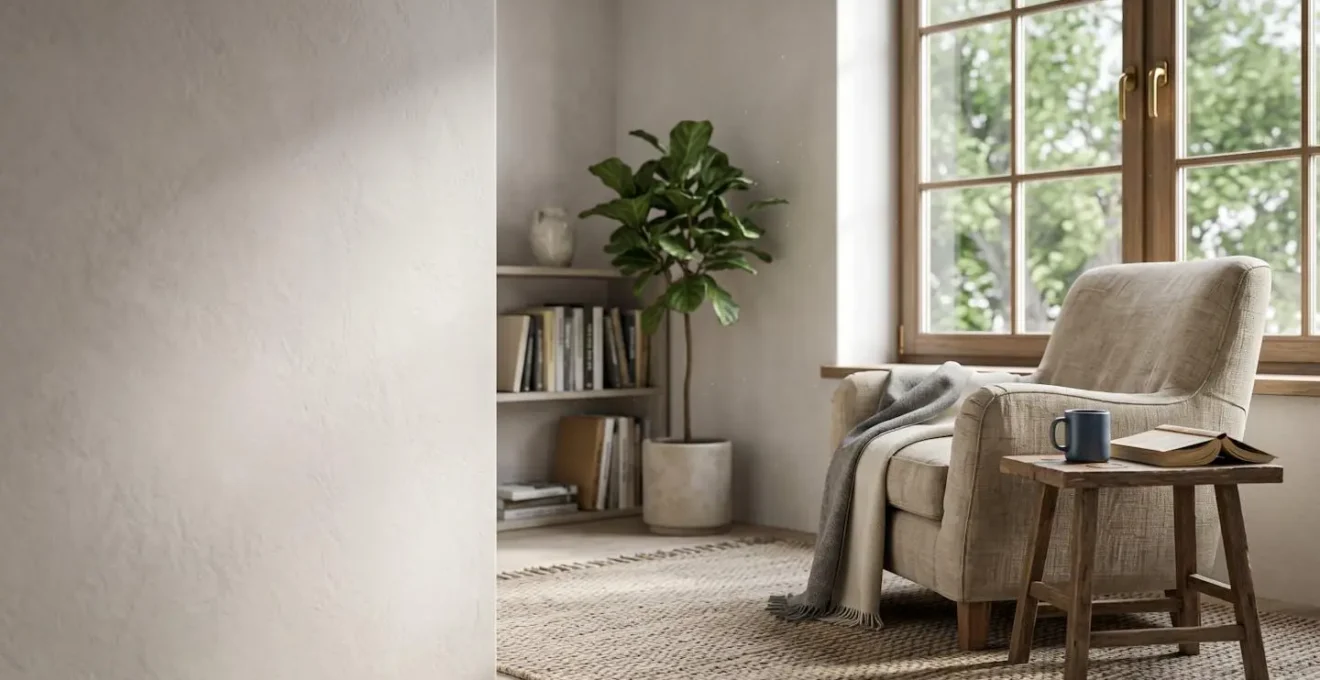
The key to believable virtual worlds isn’t photorealistic detail, but psychological authenticity.
- Sterile, perfect environments are rejected by the human brain; authenticity lies in believable imperfection, wear, and asymmetry.
- Character presence is conveyed not by objects, but by the « narrative residue » they leave behind—the subtle evidence of habits and history.
Recommendation: Stop decorating sets and start directing the audience’s subconscious by embedding psychological anchors that trigger a sense of memory and lived-in history.
As a UK animator, you’ve likely spent countless hours mastering modelling, texturing, and lighting. You build a 3D room with technical precision, every asset perfectly placed, every surface gleaming. Yet, the final render feels… empty. It’s a showroom, not a home. A sterile stage, not a world with a past. The common advice is to « add more detail » or « tell a story, » but these platitudes rarely address the core issue: a disconnect between technical execution and psychological believability. Your scene might be physically accurate but emotionally vacant, leaving the audience as a detached observer rather than an immersed participant.
The industry often focuses on the ‘what’—using physically-based rendering (PBR), high-poly models, and complex shaders. But this approach misses the ‘why’. Why does a slightly crooked picture frame feel more real than a perfectly aligned one? Why does a worn-out armchair communicate more than a brand-new sofa? The problem isn’t a lack of polygons; it’s a lack of humanity imprinted on the space. True environmental storytelling goes beyond set dressing. It’s about understanding the subtle, subconscious cues that make a space feel inhabited, historical, and authentic.
This guide moves beyond the surface-level advice. We will not be creating a checklist of props to add. Instead, we’ll explore the psychological principles that transform a sterile 3D environment into a convincing, lived-in world. The secret lies not in adding more, but in adding what’s right—the calculated imperfections, the traces of unseen habits, and the emotional resonance of light and shadow. We will shift your focus from simply building a set to sculpting an atmosphere, creating a world that feels real because it whispers stories of the people who exist, or existed, within it.
To achieve this, we will deconstruct the core elements of environmental storytelling, moving from foundational principles of authenticity to advanced strategies for long-term world-building. This structure will provide you with a comprehensive framework for breathing life into your virtual creations.
Summary: From Empty Stages to Lived-In Worlds
- Why Do Perfectly Symmetrical 3D Rooms Feel Fake Compared to Messy Ones?
- How to Show Someone Lives Here Without Showing the Person on Screen?
- Flat Lighting or Dramatic Shadows: Which Makes Your Virtual Space Feel Real?
- The Perfect Background Nobody Looks At While Foreground Feels Empty
- Should You Build 50 Reusable Wall Pieces or 5 Unique Complete Rooms?
- The Unused Lore That Confuses Audiences Without Enhancing Stories
- How to Show « Economic Inequality » Visually Without Charts or Voiceover?
- How Do You Build Fantasy Worlds That Make Sense Across 50 Episodes?
Why Do Perfectly Symmetrical 3D Rooms Feel Fake Compared to Messy Ones?
The core reason perfectly symmetrical and pristine 3D environments feel artificial is that they defy a fundamental law of existence: entropy. In the real world, everything is in a constant state of decay, use, and subtle chaos. Our brains are subconsciously trained to recognise this. A perfectly mirrored room, with objects aligned to a grid and surfaces untouched by wear, triggers a cognitive dissonance. It’s an « uncanny valley » of environments, where the technical perfection makes it feel less real, not more. Authenticity isn’t born from flawlessness; it’s born from believable imperfection.
This principle of « imperfection as authenticity » means you must actively fight against the default tidiness of 3D software. Think like an archaeologist, not just an architect. A real room is a collection of layered histories. Dust settles unevenly, floorboards creak in high-traffic areas, and paint peels near a source of moisture. These are not random details; they are the logical outcomes of a space interacting with time, physics, and human behaviour. Introducing slight asymmetry—a chair not perfectly pushed in, a stack of books leaning slightly, a rug that is subtly off-centre—breaks the digital rigidity and signals to the viewer’s brain that this space is governed by the same natural laws as their own.
Case Study: Environmental Realism in Animation
This concept is supported by research into what makes animated worlds compelling. A 2024 study on ecological storytelling in films like The Lion King and Moana found that audiences form stronger connections with virtual environments that mirror real-world organic patterns. The key finding was that asymmetry and natural wear patterns are essential for authenticity, as they ground the fantastical in a reality the audience intuitively understands. A world feels more immersive when it shows the scars and imperfections of its own history.
Therefore, your first task as an environmental storyteller is to become a master of controlled chaos. Don’t just place assets; position them with intention. Consider the forces that would act upon them. Has a window been left open, causing curtains to shift? Does a character always drop their keys on the same spot on the table, creating a small scuff? These minute details, when logically implemented, accumulate to create a powerful, subconscious sense of realism that a perfectly symmetrical room can never achieve.
How to Show Someone Lives Here Without Showing the Person on Screen?
The presence of a character is not established by the objects they own, but by the traces of their habits left upon those objects. This is the concept of « narrative residue. » A sterile room can be filled with props—a guitar, a laptop, a stack of books—and still feel empty. But a room that shows how those items are used tells a story. Is the guitar dusty in its stand, or is it out of its case with a capo clipped to the headstock and a well-worn pick tucked under the strings? The first scenario suggests an abandoned hobby; the second screams active musician. You are showing not the person, but the ghost of their recent actions.
This idea of making the intangible visible is a core strength of animation. As expert Dr Rayna Denison notes in a workshop on environmental storytelling:
Animation is so effective for telling environmental stories for three reasons: first, its capacity for abstraction. Animations can give form to the invisible or the intangible.
– Dr Rayna Denison, University of Bristol Workshop
To create this « narrative residue, » focus on the small interactions. A half-finished cup of tea growing cold on a desk, a dent in a sofa cushion where someone always sits, a single muddy boot by the door while the other is missing—these are psychological anchors. They are specific, tangible details that imply a recent, unseen action and a consistent pattern of behaviour. They give the audience clues to build a mental picture of the inhabitant’s personality, mood, and daily routines, making the character feel present long before they ever appear on screen.
The key is layering these details to suggest a timeline of activity. A breakfast bowl still in the sink speaks to the morning’s rush. A stack of mail on the counter, with one letter opened and discarded, points to a specific moment of interaction. These are not just random props; they are evidence. By carefully placing this evidence, you transform the environment from a static backdrop into an active participant in the story.
Look at how the objects above tell a story. The worn mug with a spoon inside doesn’t just say « someone drinks coffee »; it says « someone drinks coffee here, often, and just finished. » The smudged glasses and creased book spine are the narrative residue of leisure and habit. This is how you give form to the invisible presence of your character.
Your Action Plan: Auditing a Scene for Narrative Residue
- Identify Psychological Anchors: List 3-5 key objects in your scene (e.g., a chair, a desk, a book).
- Imprint a Habit: For each object, define one specific, repeated action a character performs with it (e.g., always throws their coat over the chair).
- Create the Residue: Model or texture the physical evidence of that habit (e.g., a slight sagging in the chair’s fabric, scuff marks on the wall behind it).
- Layer a Timeline: Add one « transient » object that suggests a very recent action (e.g., a half-eaten apple, a still-lit lamp in daytime).
- Check for Contradictions: Ensure all the narrative clues tell a coherent story about the character’s personality and recent activities.
Flat Lighting or Dramatic Shadows: Which Makes Your Virtual Space Feel Real?
The answer is neither and both. The debate between flat, even lighting and dramatic chiaroscuro misses the point. The most realistic lighting is motivated lighting. It’s not about a stylistic choice between bright or dark, but about ensuring every light and shadow has a logical source and a narrative purpose. Flat, overlit scenes feel fake because, in reality, light is never perfectly uniform. It is bounced, absorbed, and blocked, creating a complex tapestry of varying intensities and colours. Conversely, overly dramatic shadows without a clear source feel theatrical and artificial. A space feels real when its lighting tells a coherent story about the time of day, the weather, the architecture, and the mood.
As the experts at Anideos Studio highlight, lighting wears many hats in storytelling:
Lighting is particularly crucial in 3D animation since it must assist the story, express the mood of a scene, and visually reflect the location, time of day, and even the weather.
– Anideos Studio, 3D Lighting In Animation
Think of light as a character in its own right. A harsh, cold, blue light filtering through blinds can communicate a sense of clinical sterility or morning loneliness. A soft, warm, golden light spilling from a lamp can create an inviting, safe haven. The quality of the light—whether it’s the diffused grey of an overcast British sky or the sharp, hard light of a midday sun—instantly grounds the viewer in a specific context. The interplay of light and shadow sculpts the form of your environment, revealing texture and creating depth. Shadows are not the absence of light; they are the evidence of objects occupying space, and they are critical for selling the reality of your scene.
To achieve this, many modern animation pipelines have embraced techniques that treat light as it behaves in the real world. The goal is to build a foundation of realism from which you can then make artistic choices. This approach is often grounded in technologies where physically-based lighting (PBL) simulates light according to real-world physics, ensuring that bounces, reflections, and falloff behave predictably. Once this realistic base is established, you can then « cheat » for emotional impact—adding a subtle rim light to guide the eye or colouring a shadow to enhance the mood. The key is that even the artistic deviations are rooted in a physically plausible foundation.
Ultimately, your lighting shouldn’t be an afterthought; it should be integrated from the beginning of the design process. It dictates what the audience sees, what they don’t see, and, most importantly, what they feel. A well-lit space feels real not because it’s bright or dark, but because every shadow feels earned and every highlight tells a part of the story.
The Perfect Background Nobody Looks At While Foreground Feels Empty
A common mistake in 3D environment design is an even distribution of detail. The animator, proud of their assets, makes every object from the foreground to the deep background equally sharp and interesting. The result is visual noise. The viewer’s eye doesn’t know where to land, and the scene paradoxically feels flat and unfocused. A « lived-in » world is not one where everything is detailed; it’s one where detail is used strategically to create a visual hierarchy of attention. Just like in cinematography, you must direct the viewer’s eye to a specific focal point, or « entry point, » into the scene.
This means consciously dividing your environment into layers: foreground, midground, and background. The highest level of detail, texture fidelity, and lighting contrast should be reserved for the foreground and key areas of the midground where the story is happening. The background’s job is not to compete for attention but to provide context and atmosphere. It should be simplified, with softer focus, lower contrast, and less saturated colours. This mimics how the human eye and camera lenses perceive depth, immediately creating a more realistic and immersive sense of space.
Notice in the image above how your eye is immediately drawn to the hand and the notebook in the foreground. They are sharp, well-lit, and tell a story. The furniture in the midground is recognisable but softer, and the background dissolves into an atmospheric blur of light. This isn’t a lack of detail; it’s a deliberate and professional control of detail. This technique gives the foreground objects a tangible presence and prevents the background from overwhelming the composition.
Your goal is to create « islands of clarity » in a « sea of atmosphere. » Decide what the most important narrative beat of the scene is. Is it a character’s interaction with a prop? A specific architectural feature? A clue left on a table? That is your hero element. Lavish your attention there. Everything else in the scene should play a supporting role, contributing to the overall mood without stealing the spotlight. This approach not only creates a more compelling composition but is also far more efficient from a production standpoint, saving valuable time and rendering power.
Should You Build 50 Reusable Wall Pieces or 5 Unique Complete Rooms?
This question presents a false dichotomy. The most effective and professional approach to building expansive, believable worlds is a hybrid one: using a modular asset workflow for the bulk of the construction, punctuated by unique « hero assets » to break repetition and add character. Building every room from scratch is incredibly inefficient and leads to inconsistency. Conversely, relying solely on a small set of repeating modules can quickly make a world feel generic and computer-generated, like a poorly designed video game level.
Modular design is the backbone of efficient world-building. It involves creating a library of standardised, reusable pieces—like wall sections, floor tiles, windows, and doorways—that can be snapped together like digital LEGO bricks. This ensures architectural consistency, speeds up the creation of large-scale environments, and optimises performance. If you need to build a city block, you don’t model 50 unique buildings; you create a kit of parts that can be combined in near-infinite ways to produce 50 distinct-looking structures. This systemic approach is fundamental to modern production.
Case Study: Production Efficiency in Modern Game Development
The power of this technique is well-documented in the games industry, a field that constantly pushes the boundaries of large-scale environment creation. An analysis of modern game development pipelines reveals that modular assets are transformative. They allow small teams to build vast, detailed worlds that would otherwise be impossible. The strategy is to use the modular kit for the « 80% » of the environment (the floors, walls, and structural elements) and then dedicate artist time to creating the unique « 20% »—the hero assets that tell a specific story and serve as focal points.
These hero assets are your narrative anchors. A unique, intricately carved fireplace in a modularly-built room immediately gives it a sense of history and importance. A bespoke, graffiti-covered storefront can define the character of an entire street built from reusable wall and window kits. The key is to think like a film set designer: the structural « flats » can be standard, but the props and set dressing are what make it unique. By combining the efficiency of a modular system with the artistic impact of handcrafted hero pieces, you get the best of both worlds: scope, consistency, and character.
The Unused Lore That Confuses Audiences Without Enhancing Stories
A common trap for creators, especially in fantasy or sci-fi, is « world-builder’s disease »: the obsessive creation of vast amounts of lore, history, and rules that are never seen or felt by the audience. A 500-page backstory on the Second Dragon War is useless if it doesn’t inform what’s on screen. Unused lore is not depth; it’s noise. True depth is achieved when lore is translated into tangible, environmental details—when it becomes part of the narrative residue. The audience doesn’t need to read an encyclopedia about the city’s founding; they need to see the ancient, worn-down stones of the original city wall running through a modern district.
The purpose of lore is to serve as a guide for consistency, not as a script to be recited. It should answer the ‘why’ behind your design choices. Why is this district impoverished? Your lore might state it’s because a magical river, the city’s original lifeblood, was diverted a century ago. You don’t show this with a voiceover. You show it with the dry, cracked riverbed now used as a makeshift road, with buildings featuring architecture (like boat hitches) that is now nonsensical. The lore provides the logic; the environment provides the evidence.
When lore is not effectively translated, it can actively confuse the audience. If you design a character with a sigil on their armour that has a deep, complex meaning in your notes but is never referenced or explained visually, it becomes a distracting, meaningless symbol for the viewer. It raises a question that is never answered. Effective world-building is about economic storytelling: every detail must have a purpose and contribute to the viewer’s understanding, even if that understanding is subconscious. If a piece of lore doesn’t result in a visible, feelable element in the world, it should be cut or saved for an appendix.
Before adding any element based on your lore, ask yourself: « Does this detail help the audience understand the character, the plot, or the theme? » If the answer is no, it’s likely self-indulgent. The goal is to create a world that feels like it has a history, not a world that requires a history lesson to be understood. The story of the past should be written in the rust, cracks, and customs of the present.
How to Show « Economic Inequality » Visually Without Charts or Voiceover?
Showing an abstract concept like economic inequality is the ultimate test of environmental storytelling. It requires you to synthesize every principle we’ve discussed: imperfection, narrative residue, and visual hierarchy. You don’t need a single line of dialogue. You show it through contrast and material storytelling. The most powerful method is to juxtapose two environments, allowing the audience to draw their own conclusions from the visual evidence.
First, establish a baseline in one environment. Let’s say it’s a wealthy district. Here, the materials tell the story. Surfaces are made of marble, polished hardwood, and brass—materials that are expensive and require maintenance. The « imperfections » are subtle: a faint patina on the brass, the gentle grain of the wood. The narrative residue speaks of leisure: pristine books that look unread, decorative art, technology that is sleek and integrated. The very air feels clean, with light that is likely designed and artificial, casting soft, flattering glows. The architecture is spacious, perhaps even wastefully so, with high ceilings and large, clear windows.
Now, contrast this with a poor district. The materials are a patchwork of cheap, functional, and repurposed items: corrugated iron patching a hole in a brick wall, plastic sheeting for a window, cinder blocks for a staircase. Here, the imperfections are not subtle; they are the story. Rust, grime, water damage, and cracks are everywhere. This is not just « adding dirt »; it’s showing the logical result of cheap materials failing against the forces of time and weather. The narrative residue speaks of struggle and necessity. Tools are left out not from carelessness but from constant use. Every object is functional, with little room for pure decoration. Furniture is worn not with the gentle patina of age, but with the deep scars of overuse and repair.
The lighting in the poor district is likely haphazard and utilitarian—a single bare bulb, harsh fluorescent light, or deep shadows cast by towering, tightly packed buildings that block the sun. Space is a premium, so streets are narrow and homes are cramped. By cutting between these two worlds, the audience doesn’t need to be told about inequality. They feel it in the texture of the walls, the quality of the light, and the very air the characters would breathe. You have made an abstract economic concept into a tangible, sensory experience.
Key takeaways
- Authenticity comes from calculated imperfection, not flawless realism. Embrace asymmetry, wear, and the subtle chaos of real life.
- Show a character’s presence through « narrative residue »—the evidence of their habits and history left on the environment.
- Use a hybrid production model: build the world’s structure with efficient modular assets, then add character with unique « hero » props.
How Do You Build Fantasy Worlds That Make Sense Across 50 Episodes?
Building a fantasy world that remains coherent and believable over a long-form series like 50 episodes is a marathon, not a sprint. The key to long-term consistency is moving from individual, handcrafted scenes to a systemic design philosophy. This means establishing a clear and logical set of rules—a « visual grammar »—for your world and adhering to it rigorously. This grammar governs everything from architecture and materials to the way light behaves and how society leaves its mark on the environment.
This is where a modular approach truly shines. As projects like the Portalethium game development showcase, thinking in systems is essential for iteration and scale. The principle that modularity works like LEGOs, where pre-built pieces are interchangeable, is your greatest asset. At the start of the series, you don’t just build one Elven city; you design the Elven architectural kit. This kit defines the shapes, materials, and construction logic for all Elven structures. When you need to create a new Elven outpost in episode 37, you use the established kit. This ensures that it instantly feels part of the same culture, maintaining visual continuity for the audience across years of production.
This systemic approach extends beyond architecture. You should create rules for « narrative residue » specific to different cultures. For example, a Dwarven society might leave behind evidence of meticulous craftsmanship and geometric order, while an Orcish settlement might be characterized by opportunistic repairs and organic, powerful structures. By defining these cultural fingerprints early on, you create a shorthand that allows the audience to instantly recognise who built or inhabited a space, even if it’s a new location. Consistency in these details is what makes a world feel deep and real over time.
Finally, a long-running series allows for the most powerful form of environmental storytelling: showing change over time. A city that is pristine in episode 1 can be shown with fortifications and signs of wear by episode 40 if a war has taken place. A pristine forest can slowly show the encroachment of an industrial society. Because the audience has a baseline from the early episodes, these environmental changes have a profound narrative impact. They make the world feel dynamic and responsive to the events of the story, transforming it from a static background into a living, evolving character in its own right.
By moving beyond technical perfection and embracing these psychological and systemic principles, you can begin to craft virtual worlds that resonate with the depth, history, and beautiful imperfection of reality itself. The next step is to apply this thinking to your own projects, transforming your empty showrooms into truly lived-in worlds.