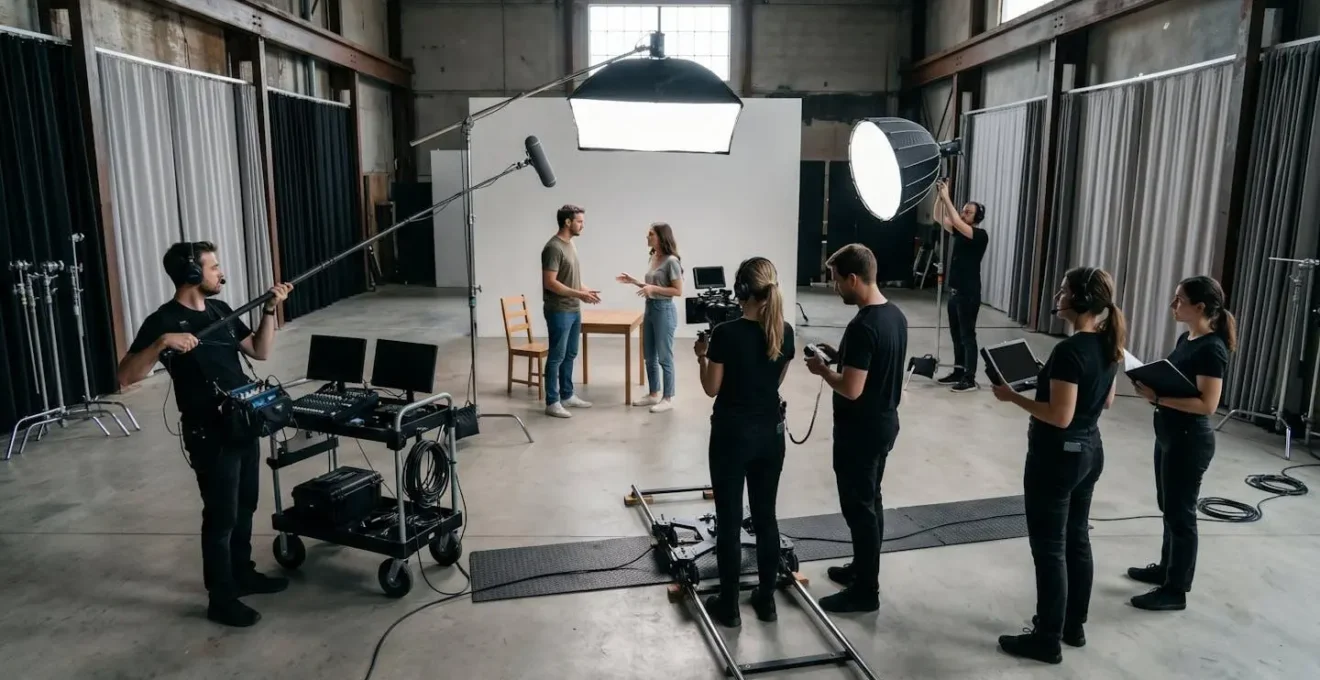
A 6-person crew’s efficiency isn’t limited by its size, but by its operational systems; fixing the system is cheaper and more effective than hiring a 7th person.
- On-set chaos, even with veterans, stems from systemic friction and ambiguous communication, not a lack of individual skill.
- Implementing clear, non-negotiable protocols for communication (closed-loop) and planning (storyboarding) are the most direct ways to reclaim hours lost to delays and reshoots.
Recommendation: Stop trying to manage chaos and start engineering efficiency. Instead of bloating your budget, focus on optimising the workflow of your existing six-person team.
You see it on every set: a team of six highly experienced professionals—a Director of Photography who can paint with light, a Gaffer who knows every circuit, a sound recordist with golden ears—and yet, the shoot is three hours behind schedule before lunch. The air is thick with the frustration of repeated questions, conflicting directions, and the grinding halt of one department waiting on another. You have the call sheet, you have the walkie-talkies, but the day is still devolving into a costly exercise in organised chaos. This is a familiar pain point for any UK production coordinator tasked with keeping the train on the tracks.
The standard advice to « communicate better » or « plan more » feels hollow in the face of this daily reality. The problem isn’t a lack of talent or a shortage of expensive equipment. The truth is far more structural. If the real key to unlocking hours of productivity wasn’t about the individual skills of the crew, but the robustness of the system they operate within? What if the constant delays are not a people problem, but a protocol problem?
This is where we shift the focus from managing personalities to engineering process. This guide is built for the production coordinator who knows adding a seventh person is often just adding to the confusion. We will dissect the systemic failures that create on-set friction and provide concrete, protocol-driven solutions. We will explore how to resolve inter-departmental conflicts before they start, establish communication systems that eliminate ambiguity, and leverage pre-production as the ultimate time-saving tool. The goal is to transform your six-person crew from a group of talented individuals into a single, hyper-efficient production machine that consistently wraps on time, if not early.
This article provides a blueprint for optimising your crew’s performance by examining the core pillars of on-set coordination. The following sections break down the most common efficiency killers and offer actionable strategies to overcome them.
Summary: A Blueprint for On-Set Production Efficiency
- Why Do 6 Experienced Crew Members Still Create Chaos Without Clear Systems?
- How to Stop Lighting and Camera Crew Disagreements Delaying Every Setup?
- Walkie-Talkies or Shouting: Which Prevents the Miscommunication Costing 2 Hours Daily?
- The Skipped Lunch Break That Reduced Afternoon Productivity by 50%
- Should You Hire a 7th Person or Improve How 6 People Work Together?
- Why Do Storyboarded Shoots Finish 4 Hours Faster Than Unstoryboarded Ones?
- How to Film Family Dinners Where Everyone Forgets You’re Recording?
- How Can Storyboards Prevent the Miscommunication That Costs 10 Reshoots?
Why Do 6 Experienced Crew Members Still Create Chaos Without Clear Systems?
The paradox of modern film production is that you can assemble a crew with a combined century of experience and still watch your schedule disintegrate. The reason isn’t a lack of talent; it’s the presence of systemic friction. When six experts operate with six different mental models of the next shot, the time wasted synchronising their efforts—the « synchronisation cost »—becomes your biggest budget drain. Each person makes assumptions based on their expertise, leading to a cascade of minor corrections, repeated questions, and delays that accumulate into hours.
This isn’t just an anecdotal frustration; it’s a financial black hole. The crew is often the largest single expense category in a production budget, and inefficient coordination directly inflates this cost. Without a unified operational framework, individual expertise creates islands of efficiency in an ocean of chaos. As film production research highlights, « Collaborative film production structures emphasize the importance of interdepartmental communication and coordination. » The keyword here is « structures. » Without them, you’re not managing a crew; you’re just herding talented cats.
The solution isn’t about micromanagement but about establishing a shared operational language and a universally accepted plan. When the gaffer, key grip, and DP all know the next three setups—not just the next one—they can work in parallel, not in sequence. This shift from reactive problem-solving to proactive execution is only possible when a clear system replaces individual interpretation as the primary driver of on-set activity. The goal is to make the « right » way of doing things the easiest way, eliminating the cognitive load of constantly re-negotiating the process.
How to Stop Lighting and Camera Crew Disagreements Delaying Every Setup?
The classic on-set conflict between the lighting and camera departments is a perfect microcosm of systemic failure. The Director of Photography has a vision, the Gaffer has a pragmatic understanding of power and time, and the First AD is watching the clock. When these three departments aren’t perfectly synchronised before the first C-stand is moved, you’re guaranteed to lose time. The disagreement isn’t personal; it’s a direct result of incomplete information and a lack of a shared, pre-validated plan.
The most effective tool to prevent this is the « technical huddle. » This isn’t a casual chat; it’s a mandatory, five-minute meeting before each major scene change involving the key decision-makers: the Director, DP, Gaffer, and First AD. The goal is to walk through the storyboard or shot list, confirm blocking, identify potential lighting challenges, and agree on the execution sequence. This simple protocol moves the discussion from the middle of a chaotic set to a controlled, proactive forum. It transforms potential conflict into collaborative problem-solving.
This proactive alignment is the cornerstone of complex and efficient productions. By front-loading the decision-making process, you eliminate the costly on-the-fly adjustments that kill momentum. The crew works with confidence, knowing that the plan has been vetted by all key departments.
Case Study: Birdman’s Continuous-Shot Coordination
Alejandro González Iñárritu’s masterpiece, Birdman, exemplifies the power of systematic coordination. To achieve the illusion of a single continuous take, the production required unprecedented synchronisation between actors, camera movements, and lighting cues. This was not left to chance. Through rigorous script breakdowns and planning, the crew mapped out every detail in pre-production. This allowed them to pre-plan complex lighting setups and camera choreography, ensuring that every department knew its role a dozen steps ahead, a process that ultimately led to critical and commercial success by turning potential chaos into a seamless visual ballet.
Walkie-Talkies or Shouting: Which Prevents the Miscommunication Costing 2 Hours Daily?
The choice isn’t really between walkie-talkies and shouting; it’s between structured communication and noise. Handing everyone a radio without a protocol is just a way to broadcast confusion more efficiently. The root of costly miscommunication is ambiguity. An instruction like « move the light back a bit » is useless. How far is « a bit »? Which light? Who confirms the action is complete? This is where hours are lost every day—in the gaps created by imprecise language and unconfirmed instructions.
The solution is to treat on-set communication with the same rigour as military or aviation operations, where mistakes are catastrophic. Implementing a Closed-Loop Communication Protocol is non-negotiable. This simple system has two parts: the sender gives a clear, concise instruction, and the receiver must repeat the instruction back in their own words for confirmation before acting. For example: « Grip department, copy. You want the 10K Fresnel moved two metres to camera left. » This instantly eliminates misunderstandings and ensures everyone is operating from the same information.
This protocol must be supported by a clear channel strategy. A single, open channel for a 6-person crew is an invitation for crosstalk and missed calls. A better system involves dedicated channels for key departments (e.g., Ch 1: Production/Open, Ch 2: Camera, Ch 3: Lighting/Grip, Ch 4: Sound). This reduces noise and ensures that messages are relevant to those who hear them. For non-urgent, department-specific queries, asynchronous tools like a dedicated Slack channel can create a searchable log of decisions without interrupting the immediate flow of the set. The goal is to ensure the signal-to-noise ratio is always high and that every critical instruction is sent, received, and confirmed.
Action Plan: Implementing a Closed-Loop Communication Protocol
- Establish a clear hierarchy: Define precise communication chains from producers and directors through department heads to individual crew members. Know who reports to whom.
- Standardise radio protocols: Implement consistent walkie-talkie lingo and channel assignments (e.g., production, lighting, sound on dedicated channels) to reduce cross-talk.
- Use asynchronous tools strategically: Deploy apps like Slack for department-specific, non-urgent questions, creating a searchable log of decisions that doesn’t clog up live communications.
- Apply closed-loop confirmation: Mandate that receivers confirm instructions by repeating them back in their own words to ensure complete understanding before any action is taken.
- Maintain multi-channel systems: Break teams into departmental groups on separate walkie channels to reduce overall noise and increase the clarity of relevant signals.
The Skipped Lunch Break That Reduced Afternoon Productivity by 50%
In the frantic race against the clock, the lunch break often seems like a luxury that can be trimmed or postponed. This is a catastrophic miscalculation. A « working lunch » or a delayed break doesn’t save time; it borrows it from the afternoon at a high interest rate. A fatigued crew is a slow, unfocused, and unsafe crew. Cognitive function declines, attention to detail plummets, and the risk of simple, costly mistakes skyrockets. That « extra » 30 minutes gained by skipping a proper break is easily lost tenfold in a fumbled camera move, a misjudged focus pull, or a boom in the shot.
Beyond the immediate drop in productivity, there are legal and financial ramifications. In the UK and most professional production environments, there are strict rules governing work hours and meal breaks. For example, standard film industry labour regulations often mandate a meal break must be provided after no more than six hours of work. Ignoring these rules doesn’t just create a grumpy crew; it can trigger meal penalties, where you have to pay crew members extra for the missed break, directly impacting your budget.
As Film Production Wellness Research wisely notes, « A well-rested crew is less prone to errors and more likely to deliver creative solutions when faced with challenging scenes. » The break is not a pause in work; it is a critical part of the work itself. It is the designated time for the human equipment to refuel and reset. Protecting this time is one of the most effective, and cheapest, productivity tools a production coordinator has. It ensures the team that starts the afternoon is as sharp and capable as the one that started the morning.
Should You Hire a 7th Person or Improve How 6 People Work Together?
When a production is feeling strained, the instinct is often to throw more bodies at the problem. If a six-person crew is struggling, surely a seventh person will lighten the load. This is rarely the case. More often than not, adding a person increases the communication overhead and coordination complexity, a phenomenon known as Brooks’s Law in software development. The new person needs to be brought up to speed, roles need to be re-shuffled, and you now have 21 potential communication lines instead of 15. The true solution isn’t addition; it’s resource optimisation.
Before considering a new hire, a smart production coordinator must first conduct a ruthless audit of the existing workflow. Where is time actually being lost? Is it a lack of manpower, or is it a bottleneck in the system? More often than not, the three hours you’re losing per day can be reclaimed by fixing systemic friction—implementing the communication protocols, pre-production planning, and workflow alignment discussed throughout this guide. An optimised six-person crew operating in perfect sync will always outperform a disorganised seven-person crew.
This principle is more critical than ever in the current economic climate. In the wake of industry-wide shifts and strikes, there has been a significant downturn in production volume, with some reports citing a decline of up to 40% in the US, a trend with global ripple effects. With budgets tighter and competition for projects fiercer, the ability to do more with less is not just a skill—it’s a survival mechanism. Demonstrating that you can deliver a high-quality product on time and on budget with a lean, efficient crew is the most valuable currency you have.
Why Do Storyboarded Shoots Finish 4 Hours Faster Than Unstoryboarded Ones?
The idea that storyboarding is an optional, « nice-to-have » step for big-budget features is a dangerously expensive myth. Storyboarding is not an artistic indulgence; it is the single most powerful tool for cognitive offloading in a production’s arsenal. It takes the complex, three-dimensional scene from the director’s mind and translates it into a simple, shareable 2D document that every single member of the crew can understand instantly. This act of translation saves countless hours on set.
Without storyboards, every shot requires a lengthy verbal explanation, interpretation, and a series of trial-and-error adjustments. With storyboards, the entire crew has a visual blueprint. The gaffer can look at the boards for the next three scenes and start pre-rigging lights. The grip team can see where the dolly track needs to go. The production designer knows exactly which part of the set needs to be dressed. This enables parallel processing, where multiple departments work simultaneously towards a known future goal, rather than waiting sequentially for the director to decide on the next step. As one production planning expert puts it, « The production time you save by not storyboarding reappears on set, and it costs more there. »
The Efficiency Impact of Storyboarding
Industry analysis consistently shows that storyboarding is a massive efficiency multiplier. By defining shot specifics—camera angle, focal length, character positions—in pre-production, it creates a shared visual language. This shared understanding is what allows the grip and electric teams to pre-rig the lighting for scene five while the camera team is still shooting scene three. The visual requirements are already known and agreed upon by everyone. The storyboard offloads the complex scene geometry from the director’s brain onto a shared document, freeing up the entire crew’s mental bandwidth to focus on flawless execution rather than constant interpretation and guesswork.
Every minute spent storyboarding in pre-production can save ten minutes of costly indecision and rework on set. It is the ultimate proactive strategy, transforming the shoot from a process of discovery into a process of execution.
How to Film Family Dinners Where Everyone Forgets You’re Recording?
Coordinating a professional crew is one challenge; managing a non-professional cast in a real-life environment like a family dinner presents the ultimate test of coordination and psychological management. The goal is authenticity, but the mere presence of a camera and crew is the biggest obstacle to achieving it. The principles of efficiency here shift from speed to invisibility and trust. The key is to orchestrate a technical setup so seamless and a crew presence so minimal that the subjects can genuinely forget they are being filmed.
This requires a strategy of acclimatisation and remote presence. You can’t expect authentic behaviour from the moment the cameras roll. Instead, you must build a buffer. This involves techniques like announcing the first 20 minutes of filming are « throwaway » footage, which removes the pressure to perform and allows a natural rhythm to emerge. It also means prioritising the least intrusive elements first; a well-placed, high-quality microphone setup is less intimidating than a large camera, and once subjects are comfortable with being miked, they are less likely to notice the cameras later.
The most advanced application of this is deploying remote PTZ (Pan-Tilt-Zoom) cameras operated from another room. This drastically reduces the number of crew members in the immediate vicinity of the subjects, replacing an intrusive physical presence with a nearly invisible one. The director or a producer can act as a quiet « dinner host, » using pre-planned prompts to guide conversation gently rather than relying on the sterile « fly-on-the-wall » approach. These techniques show that extreme coordination is about psychology as much as logistics—a lesson that applies to any set where human performance is key.
Checklist: Filming for Authenticity
- Implement an acclimatisation period: Announce the first 20 minutes are a deliberate ‘throwaway’ to remove performance pressure and allow genuine behaviour to emerge naturally.
- Use a facilitator approach: Instead of being an invisible fly-on-the-wall, have a director act as a quiet ‘dinner host’ with gentle, pre-planned conversational prompts to guide the action.
- Deploy remote presence technology: Use small, remotely operated PTZ cameras with operators in another room to minimise the physical crew presence and reduce intimidation.
- Prioritise audio setup first: Install a well-placed, high-quality microphone setup (e.g., lavalieres) as it is generally less intrusive than large camera rigs.
- Allow for comfort adaptation: Once subjects are comfortable with the audio equipment, they are far more likely to ignore the presence of cameras during natural interaction.
Key Takeaways
- Chaos on set, even with an expert crew, is a system problem, not a people problem. Fix the process, not the blame.
- Implement non-negotiable, closed-loop communication protocols. « Copy that » is not enough; confirmation by repeating the instruction is essential to eliminate ambiguity.
- Storyboarding is not an artistic choice; it is a critical efficiency tool. Every hour spent on boards in pre-production saves multiple hours of confusion and rework on set.
How Can Storyboards Prevent the Miscommunication That Costs 10 Reshoots?
The storyboard is the single most effective antidote to the miscommunication that leads to costly reshoots. It functions as the undisputed source of truth for the visual aspects of a production. When the director, DP, and production designer all have different images in their heads for a given scene, the result is wasted time, wasted resources, and creative frustration. A storyboard externalises the vision, forcing alignment and clarity long before the expensive clock of a shooting day starts ticking.
This tool is so fundamental that it is a non-negotiable part of the pre-production process for virtually every major film, commercial, and narrative video production. It’s not because they have bigger budgets, but because they cannot afford the cost of ambiguity. A storyboard provides a frame-by-frame contract of what is being shot. If the shot in the monitor doesn’t match the shot on the board, it’s immediately clear that something is wrong, allowing for instant correction rather than a painful discovery in the editing suite weeks later. This visual reference prevents the « I thought you meant… » conversations that are the death of any schedule.
The comparison between a production that uses storyboards and one that doesn’t is stark. It is the difference between building a house with a detailed architectural blueprint and building one where the carpenters, plumbers, and electricians all show up and try to figure it out on the day. The outcome might eventually be a house, but it will be over budget, behind schedule, and full of compromises. The following table, based on common industry observations, breaks down the clear advantages.
| Production Aspect | With Storyboards | Without Storyboards |
|---|---|---|
| Pre-Visualization | Clear visual roadmap established before production | Creative decisions made on-the-fly during expensive shooting time |
| Crew Alignment | Entire team knows exactly what’s expected from each scene | Improvisation and uncertainty requiring constant clarification |
| Problem Detection | Issues identified early in pre-production when changes are free | Problems discovered on set where changes cost time and money |
| Resource Efficiency | Avoids miscommunication, reshoots, and reworks | Higher risk of costly mistakes and production delays |
| Creative Solutions | Visual thinking sparks creative solutions within constraints | Limited time for creative problem-solving under production pressure |
The path to reclaiming those lost three hours a day is not paved with more money or more people, but with smarter systems. It begins by treating coordination not as a soft skill but as a technical discipline. Stop managing chaos and start engineering efficiency. Implement one of these protocols on your next shoot and measure the difference for yourself.