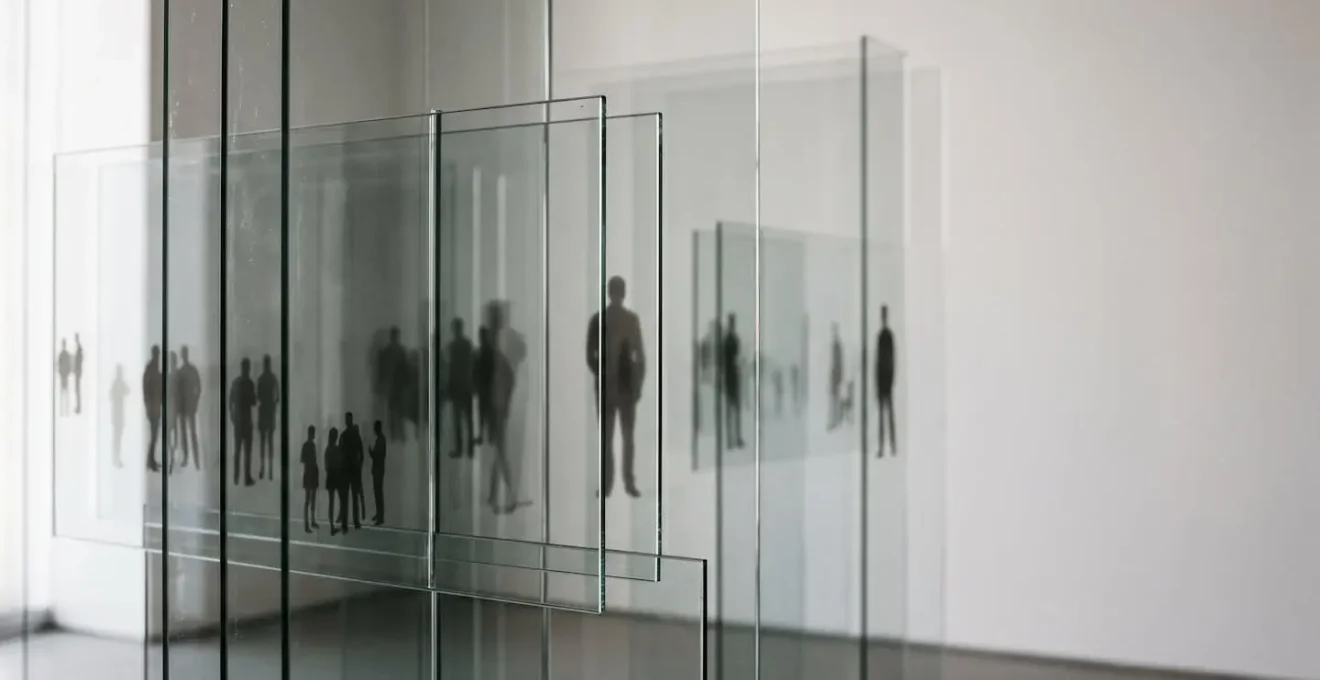
Your powerful human stories are failing to land a systemic critique because they inadvertently hide the very structures you want to expose.
- The « Identifiable Victim Effect » creates intense but misplaced empathy, focusing audiences on individual tragedy rather than policy failure.
- True systemic storytelling requires a visual grammar that makes abstract forces—like bureaucracy, economic models, or historical policy—a tangible character in your film.
Recommendation: Shift your focus from just documenting outcomes to visually constructing the ‘connective tissue’ between a person’s struggle and the systemic cause, using cinematic language to reveal the pattern, not just the pain.
As a documentary filmmaker in the UK, you’ve likely experienced the paradox. You spend months, even years, crafting a deeply moving film about a family facing eviction, a worker exploited by the gig economy, or a community ravaged by pollution. Your film premieres, the audience weeps, and critics praise its « raw humanity. » Yet, the conversation rarely moves beyond the personal tragedy on screen. The systemic failures, the decades of policy decisions, the invisible economic architecture that produced this suffering—they all remain frustratingly out of focus. You’ve made your audience feel, but have you made them see?
The standard advice offers a false dichotomy. On one hand, you’re told to « find a compelling character, » a path that often leads to emotionally powerful but politically inert storytelling. On the other, you’re advised to « use data and experts, » a route that risks boring your audience into apathy with charts and talking heads. This binary choice is a creative dead end. It forces you to choose between a story that is felt but not understood, and a lecture that is understood but not felt.
But what if the true art of systemic storytelling lies not in this choice, but in rejecting it entirely? The key is to develop a visual grammar that makes the system itself a compelling character. It’s about building narrative and cinematic ‘connective tissue’ that inextricably links the individual tearful close-up to the cold, hard policy document that engineered the tears. This approach moves beyond portraying victims of a system to revealing the very mechanics of that system on screen.
This guide will deconstruct the cognitive traps that limit traditional narratives and provide a practical framework for filming systemic inequality. We will explore concrete visual techniques, narrative structures, and editorial strategies that allow you to expose the patterns, rules, and power dynamics that shape our world, transforming your filmmaking from mere documentation of suffering into a powerful tool for structural critique.
Summary: Visualising the Invisible Architecture of Inequality
- Why Do Personal Stories Make Viewers Cry but Miss the Policy Failures Causing Them?
- How to Make « Structural Discrimination » Visible Without Just Showing Individual Prejudice?
- Statistics or Stories: Which Reveals Systemic Housing Inequality More Effectively?
- The Both-Sides Framing That Hid Decades of Documented Systemic Failure
- How to Show Climate Crisis Reality Without Creating Paralysing Despair?
- How to Show « Economic Inequality » Visually Without Charts or Voiceover?
- The Implied Causation That Undermines 6 Months of Careful Research
- How Can Independent Filmmakers Fact-Check Claims Without £20K Research Budgets?
Why Do Personal Stories Make Viewers Cry but Miss the Policy Failures Causing Them?
The fundamental reason your poignant character studies fail to ignite systemic change lies in a cognitive bias known as the « Identifiable Victim Effect. » Our brains are wired to respond with immense empathy and a desire to help a single, vivid individual in distress. However, this powerful emotional response plummets when confronted with a large, abstract group of « statistical victims, » even if that group represents a far greater scale of suffering. This means an audience will donate more to save one specific child than to a programme that could save thousands from the same fate.
As filmmakers, we instinctively leverage this effect. The tight close-up on a tear-streaked face is our most reliable tool for emotional engagement. Yet, in doing so, we trap the audience’s focus at the individual level. They see a personal tragedy, a story of bad luck or poor choices, rather than the outcome of a flawed system. The policy failure, the budget cut, the discriminatory algorithm—these are statistical, faceless forces that the Identifiable Victim Effect makes our brains tune out. The very tool that makes your film moving is what makes its systemic argument invisible.
This isn’t just folk wisdom; it’s a well-documented psychological phenomenon. The impulse to help is triggered by specific, emotionally salient details, not by the intellectual understanding of a widespread problem. As researcher Deborah A. Small notes in her work on the subject, the effect is driven by precise psychological triggers.
controlled experiments test isolated psychological factors, including specificity, vividness, and proportion of a reference group
– Deborah A. Small, On the Psychology of the Identifiable Victim Effect, Oxford Academic
The challenge, therefore, is not to abandon powerful stories but to consciously build narrative bridges that lead the viewer’s powerful, individual-focused empathy towards the abstract system. Your film must guide the audience from « What can I do for this person? » to « What is the system that created this person’s problem, and how can we fix it? ». It requires acknowledging that people show a stronger tendency to help specific victims than statistical groups, and then using that tendency as a starting point for a much larger investigation.
How to Make « Structural Discrimination » Visible Without Just Showing Individual Prejudice?
Structural discrimination isn’t about a single person with hateful beliefs; it’s about a system whose procedures, rules, and environments create discriminatory outcomes, regardless of the intentions of the people within it. Filming this requires a shift in focus from perpetrators to architecture. You must make the environment, the bureaucracy, and the process itself the antagonist. Instead of searching for a villain to embody prejudice, you can make the system’s hostile design the visible source of conflict.
Consider how to visually represent a process designed to wear people down. This could be through the physical space of a benefits office, a courtroom, or a housing authority. Long, empty corridors, confusing signage, uncomfortable seating, and impassable counters can be filmed not as background, but as active agents in the story. These are the tools of structural hostility, and they are eminently cinematic. By using techniques like wide-angle lenses to emphasize oppressive scale or focusing on the texture of decaying institutional materials, you can make the audience feel the dehumanising weight of the system.
This approach of ‘environmental storytelling’ allows you to show discrimination in action without needing to find a person explicitly stating a prejudiced view. The oppressive atmosphere of the space does the work for you, becoming a visual metaphor for the systemic barriers your characters face.
As this image suggests, the architecture of power can be more telling than any single line of dialogue. The repetition, the coldness, the sheer scale—all these elements communicate a feeling of individual powerlessness against an impersonal force. When your character is dwarfed by this environment, the audience understands that their struggle isn’t just with one unhelpful clerk, but with the entire building and the ideology it represents. The pattern of the architecture reveals the pattern of the system.
Statistics or Stories: Which Reveals Systemic Housing Inequality More Effectively?
The debate between using statistics or personal stories to show housing inequality is a false one. The most effective method is to fuse them into a single narrative device: the longitudinal case study of a place. Instead of telling one family’s story or showing one city-wide chart, you trace the history of a single house, apartment building, or street over decades. This technique transforms an abstract systemic issue into a concrete, evolving drama where the property itself is the main character.
Imagine your film opening on a family moving into a newly built council house in the 1970s, full of hope. You then follow that same house as policies change. We see the impact of Right to Buy in the 80s, the slow decline in maintenance in the 90s, its sale to a private landlord in the 2000s, and the precarious, high-rent existence of the tenants living there today. Through this single, consistent location, the audience witnesses the direct consequence of decades of housing policy. The data is no longer an abstract chart; it’s written on the peeling paint and the rising rent of a place they’ve come to know.
Case Study: The Chronological Housing Analysis Method
This filmmaking approach is grounded in academic methods that reveal systemic patterns over time. Research into housing inequality demonstrates how tracking a single location can expose deep-seated disparities. An analysis of a location across different time periods shows how families from different socioeconomic backgrounds receive vastly different treatment from the same housing system. By adopting this chronological lens, a filmmaker can visually demonstrate how policy changes and economic shifts directly impact the lives playing out within the same four walls, making the systemic pattern undeniable.
This method brilliantly combines the emotional power of the identifiable ‘victim’ (in this case, the home and its inhabitants) with the undeniable evidence of statistical trends. The audience connects emotionally to the families passing through, but the repetition of the pattern over time forces them to look for a larger cause. They see that it isn’t just one family’s bad luck; it’s a systemic trajectory. The story is the data, and the data tells a story.
The Both-Sides Framing That Hid Decades of Documented Systemic Failure
One of the most insidious traps for filmmakers tackling systemic issues is the journalistic reflex of « both-sides-ism » or false balance. This is the practice of presenting two opposing viewpoints as equally valid, even when one is supported by an overwhelming consensus of evidence and the other is a fringe, unsubstantiated opinion. While it may feel « fair » or « unbiased, » it is a profound act of distortion when covering documented systemic failures. Giving equal airtime to a climate scientist and a climate denier, for example, doesn’t create balance; it manufactures doubt and actively misleads the audience.
When you are documenting a systemic problem like racial bias in policing, financial deregulation, or environmental collapse, there aren’t two equal « sides. » There is the documented reality of the system’s failure on one side, and on the other, there are the narratives used by those in power to deny, deflect, or obscure that reality. Presenting these as a simple debate is a catastrophic narrative error. It implicitly tells the audience that the systemic failure itself is still up for debate, when the evidence—which your film should be presenting—proves otherwise.
The damage caused by this framing is not theoretical. As Cambridge Core research points out, its primary effect is to sabotage the audience’s ability to reason soundly.
false balance affects audiences specifically by priming them to engage in unsound reasoning – a fact that has been notoriously exploited by profit-driven power-holders and corporations to muddy public understanding of settled science
– Cambridge Core research, The epistemic dangers of journalistic balance, Episteme Journal
This is precisely why systemic storytelling must abandon false balance. Your duty is not to host a debate but to present the evidence of the system’s function and dysfunction. This is backed by studies showing that exposure to both-sides framing reduces perceived scientific consensus and belief in the issue. Your film’s narrative authority comes from the strength of your research and the clarity with which you build your case, not from a performative neutrality that ultimately serves to protect the status quo.
How to Show Climate Crisis Reality Without Creating Paralysing Despair?
Presenting the overwhelming reality of a systemic crisis like climate change carries a significant risk: paralysing the audience with despair. When a problem feels too vast, too catastrophic, and too inevitable, the natural human response is not to act, but to shut down. Doom-and-gloom narratives, while factually accurate, can be counterproductive, fostering a sense of futility that is the enemy of engagement. A film that leaves its audience feeling hopeless has failed, no matter how powerfully it depicted the problem.
The antidote to despair is not false optimism or downplaying the crisis. It is agency. Your narrative must pivot from simply diagnosing the problem to showcasing credible pathways for action. This doesn’t mean ending with a simplistic « 5 ways you can help » list tacked on after 85 minutes of dread. It means weaving stories of response, resistance, and innovation into the fabric of the film itself. The focus must shift from what is being lost to what is being done to save it.
This approach, often called « solutions journalism, » is about rigorous, evidence-based reporting on responses to social problems. For a filmmaker, this means finding the characters and communities who are not just victims of the crisis, but are actively building solutions. These could be engineers developing new technologies, lawyers fighting for policy change, or indigenous groups implementing traditional land management practices. By giving these stories screen time, you change the emotional calculus of your film from a eulogy to a call to action.
The goal is to leave the audience with a sense of « informed hope » – an understanding of the gravity of the situation, paired with a clear-eyed view of the tangible efforts being made to address it. It’s a delicate balance, as researchers on the topic have found.
documentaries must incite a desire to act by not only eliciting an emotional response but also by offering specific advice on what individuals can do to address climate change and encouraging collective action
– Researchers on documentary impact, The Impact of Climate Documentaries on Environmental Activism, Earth.org
Ultimately, showing the reality of the climate crisis requires you to show the full picture: the problem *and* the response. Your film’s narrative arc should guide the viewer through the stages of awareness, concern, and finally, empowerment. By focusing on collective action and tangible solutions, you don’t just avoid despair; you actively build the momentum for change.
How to Show « Economic Inequality » Visually Without Charts or Voiceover?
Economic inequality is an abstract concept. You can’t point a camera at « wealth disparity. » To make it visible, you must learn to read and film the physical world as a text that reveals economic divides. This requires a specific visual grammar focused on three elements: verticality, spatial hierarchy, and material contrast. By mastering these, you can make the invisible structures of class tangible and cinematic, entirely without resorting to explanatory voiceover or data visualisations.
Verticality is the most primal visual metaphor for hierarchy. High and low. A penthouse apartment versus a basement flat. One character looking down from a balcony while another looks up from the street. Filming from low angles to make the structures of the wealthy seem towering and oppressive, and from high angles to make the spaces of the poor seem confined and exposed, immediately communicates a power dynamic. Spatial hierarchy builds on this. Who has more space? Who has privacy? Who has access to light and air? The sheer volume of a room, the size of a window, the distance between neighbours—these are all potent visual indicators of economic status.
Finally, material contrast provides rich, tactile evidence of inequality. This can be filmed in macro detail: the juxtaposition of polished marble against cracked concrete, pristine hardwood against peeling linoleum, stainless steel against rusting iron. The textures of the world are a direct reflection of the resources available to maintain them. An extreme close-up on the junction where these materials meet can be more powerful than any statistic.
Case Study: The Visual Language of Bong Joon-ho’s ‘Parasite’
No filmmaker has mastered this visual grammar more effectively than Bong Joon-ho in his film *Parasite*. An academic analysis of the film’s visual language highlights its systematic use of space to represent class. The wealthy Park family lives in an elevated, minimalist mansion with vast windows and a sun-drenched garden, physically located high up in the city. In stark contrast, the impoverished Kim family inhabits a cramped, subterranean « semi-basement » apartment, where the only view is of the street level outside their window. The constant visual motif of stairs—climbing up to wealth, descending into poverty—serves as the film’s central ‘connective tissue’, making the socio-economic ladder brutally literal and physical.
By learning from masters like Bong Joon-ho, you can train your eye to see and capture the evidence of economic inequality that is written into our very environment. It is a language of space, light, and texture that, once understood, can tell a profound systemic story without a single word of explanation.
The Implied Causation That Undermines 6 Months of Careful Research
Perhaps the most subtle but damaging mistake in systemic storytelling is creating implied causation. This happens in the edit suite. You have powerful footage of an individual’s struggle and equally compelling footage of a macro-economic force, and you juxtapose them. For example: a shot of a politician signing a bill, cut with a shot of a family being evicted. The cut implies a direct causal link, but it doesn’t prove it. If the link is not explicitly built and proven, you risk oversimplifying a complex chain of events and opening your film to accusations of manipulation.
A viewer might see that edit and think, « It can’t be that simple. » They might blame the family’s personal choices or other intermediate factors, and your systemic argument is lost. The antidote to weak implied causation is to build an explicit and undeniable causal chain through sequential editing. Your job as a storyteller is to lay out the dominoes one by one, so when the last one falls, the audience has seen every step of the process. You must show the connective tissue, not just assume the audience will infer it.
This means meticulously tracing the path from cause to effect. You don’t just cut from the policy to the pain. You show the policy being enacted, then you show the regional office implementing the new rule, then you show the local bureaucracy changing its procedures, then you show the notice being sent to the individual, and *then* you show their personal crisis. By building this chain, you make the system’s role irrefutable. You are not just implying; you are demonstrating.
This disciplined approach transforms the edit from a tool of emotional juxtaposition to a tool of forensic analysis. The following checklist provides a framework for auditing your edit to ensure you are building strong, explicit causal chains rather than relying on weak, implied connections.
Your Action Plan: Editing for Explicit Causal Chains
- Establish Root Cause First: Begin the sequence by showing the root systemic event (e.g., a policy change, an institutional decision, an economic shift) before introducing its individual impact.
- Build Sequential Links: Use sequential editing to construct a clear causal path. For instance, show the factory closure, then the crowded unemployment office, and finally, the individual’s resulting desperation. This avoids false correlation.
- Connect Macro to Micro: Employ techniques like split-screen or multi-frame layouts to visually and simultaneously link macro forces (e.g., stock market fluctuations, legislative sessions) with their micro consequences in real-time.
- Create Temporal Bridges: Edit sequences that trace backward in time. Start with the individual tragedy and then methodically rewind, revealing the institutional failure and, ultimately, the policy origin that set events in motion.
- Use Visual Repetition for Pattern Recognition: Show multiple, different individuals encountering the exact same systemic barrier. This repetition makes the structure itself the focal point, shifting blame from personal failing to a flawed system.
Key Takeaways
- Individual stories create powerful empathy, but only narrative ‘connective tissue’ can channel that emotion towards understanding the systemic cause.
- Master a visual grammar of systems—using space, verticality, material contrast, and sequence—to make abstract structures a tangible, visible character in your film.
- Avoid the traps of false balance and implied causation; instead, build explicit, evidence-based causal chains that lead the viewer from policy to person.
How Can Independent Filmmakers Fact-Check Claims Without £20K Research Budgets?
For the independent filmmaker, the challenge of upholding journalistic rigour without the budget of a major studio can feel insurmountable. A single fact-checker or research consultant can cost tens of thousands of pounds, a sum that is simply out of reach for most. However, a lack of funds does not have to mean a lack of accuracy. By adopting a strategy of transparent and collaborative verification, you can build credibility and rigour directly into your filmmaking process, often at little to no cost.
The core principle is to shift from a closed, post-production verification model to an open, production-integrated one. Instead of paying someone to check your facts after the film is cut, you build the verification process into the narrative and visual language of the film itself. This involves leveraging partnerships, using primary sources as story elements, and making the act of verification part of the aesthetic. As the Visual Narratives of Inequality working group at Duke University states, this process is central to the film’s purpose.
showing the human effects of unjust policies is a powerful tool for informing policymaking in the present—and working towards a more equitable future
– Visual Narratives of Inequality working group, Duke University Social Equity research initiative
This approach not only saves money but can also enhance the film’s authenticity and authority. When an audience sees a key claim supported by an on-screen primary document—a redacted internal memo, a court filing, an archival news report—their trust in the narrative is significantly strengthened. You are not just telling them what happened; you are showing them the proof. The following strategies offer practical pathways for achieving this on an indie budget.
Your Checklist: Budget-Conscious Fact-Checking Strategies
- Partner with University Departments: Collaborate with university journalism, law, or research departments. Students can gain invaluable real-world experience by providing expert verification for your film as part of their coursework.
- Show, Don’t Just Tell: Build research transparency directly into the film’s narrative. Feature primary source documents on-screen—such as court records, public documents, or archival footage—to substantiate key points visually.
- Engage in Collaborative Vetting: Work with local non-profits, community archives, and academic experts whose public service missions align with your documentary’s subject. They can often provide expert vetting and access to resources.
- Use On-Screen Citations: Employ on-screen text citations not just as a verification tool, but as a deliberate stylistic choice. This makes the film’s factual foundation part of its core aesthetic and demonstrates confidence in your research.
- Focus on Primary Source Storytelling: Construct your narrative directly from verifiable documents. Let internal memos, public records, and archived materials be the backbone of your story, turning the source itself into a narrative driver.
By embedding these practices into your workflow, fact-checking ceases to be a prohibitive final hurdle and becomes an integral part of your creative process. It turns your budgetary constraints into a stylistic strength, fostering a deeper, more transparent relationship with your audience.
Start applying this systemic grammar to your next project. By doing so, you will not only move your audience emotionally but, more importantly, equip them with the patterns and understanding needed to see—and challenge—the invisible structures that shape their world.